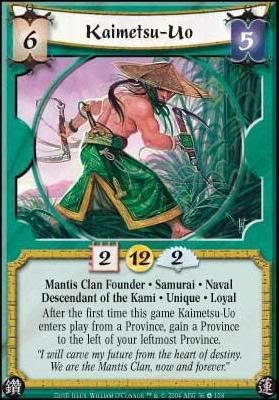
Kaimetsu-Uo lashed out with his parangu, cutting away a section of the tough vine wall. The Islands of Spice and Silk were a wild and foreboding place; the jungles at their heart were even more so. The heat had already overcome most of his men. They were used to the temperate lands of the Lion or the cool mountains of the Crab; some had foolishly attempted to brave the jungle while still wearing their armor. Kaimetsu-Uo had at least been wise enough to leave his armor and swords safe on his mother’s ship. The exhausted soldiers had been left behind to seek water and recover; he would finish this quest alone if he must. Surprisingly, Kindari had kept pace.
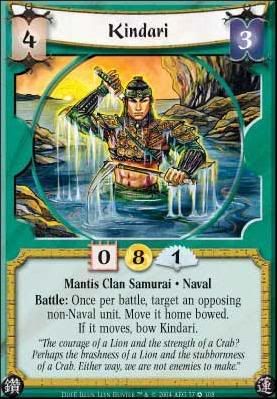
“My lord, we must turn back,” the scrawny little scout said, eyes wide as he took in the shadowy vegetation around them. The sun barely shone here; it was an overgrown world of roots and vines, echoing with the cries of strange creatures unknown in Rokugan.
“We cannot turn back,” Kaimetsu-Uo replied. He continued hacking his way through the unforgiving jungle. The former Crab was stripped to the waist, thick body streaked with grime and sweat from the endless labor. “We cannot give up when we are nearly there.”
“How can you be sure we are nearly there?” Kindari asked sharply. “None live who have seen the one you seek! We do not even know if the tales are true! We have searched for weeks!”
Kaimetsu-Uo turned, seizing the smaller samurai by his collar. “These tales were passed down from my grandfather,” he snarled, eyes narrowing. “Would you call my grandfather a liar?”
Kindari only shook his head slightly, too terrified to reply. His eyes fixed fearfully on the short chopping blade in Kaimetsu-Uo’s hand.
Kaimetsu-Uo frowned and released his vassal with a sigh. “I am sorry, Kindari-san,” he said quietly. “My anger is not meant for you but for myself. I must find my place in this world. Only here may I find the answers I seek.”
“If that is what you believe, then I stand by you to the end, my lord,” Kindari said, “but I worry for the others.”
“A point well taken,” Kaimetsu-Uo said more soberly. “I am prepared to die to find my destiny, but I would not offer that same death to those who follow me. Go back to the others and tell them to return to the ships.” He sighed deeply. “Tell my mother we will return to Rokugan in the morning. I shall search alone for one more night.”
Kindari nodded, but said nothing. Kaimetsu-Uo’s decision had not been easy; he would not cheapen that sacrifice with words. He turned away and moved back the way they had come.
Kaimetsu-Uo silently sat upon a gnarled root, burying his parangu in the ground beside him with a flick of the wrist. His face was hollow, empty as he stared at the jungle floor. Could it be that he had come all this way for nothing? Would he be denied the answers he sought?
No.
He reached for his parangu again. The others could return; he would remain. His mother would lead them well enough. A man without purpose was no man at all. He could not face them again and not know the truth.
“Ah, yes,” cackled a voice from the dark shadows of the treetops. “Few bear fury, hope, and honor in such equal measure. You are a child of the gods.”
Kaimetsu-Uo looked up, holding his weapon ready for any attack as he rose into a battle stance.
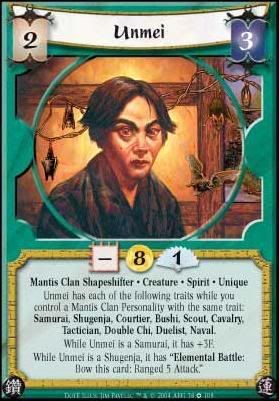
To his surprise he saw a tiny old man seated high in the branches of a twisting tree. He wore only a thick black cloak and a wide-brimmed straw hat. His wrinkled face was turned up in a mischievous smile. In the dim light of the forest, his eyes seemed to shine a milky green. Kaimetsu-Uo lowered his weapon. His eyes were wide now, exhaustion and anger replaced by hope.
“You are Unmei, the storyteller?” Kaimetsu-Uo asked.
“And you—” The old man seemed to sniff the air.
“You are a son of Hida, if I am not mistaken.” He hopped down from the tree, hobbling close to study the strange samurai more closely.
“His grandson. How did you know?”
“If you have come seeking me, then we both know what I am,” Unmei cackled. “I am a koumori, a spirit from a time before your human Empire. When the Hantei dispatched his armies to claim the lands for mankind, it was your grandfather who showed me mercy. Hida recognized we were not Fu Leng’s minions. He allowed me to flee with my kin to these islands where we would be safe. Have you come to collect on the debt I owe? Have you come for that which Hida has entrusted to me?”
The old man smiled and backed away. He leaped onto a low branch and seated himself there with astounding agility. “I think that you have.”
Kaimetsu-Uo nodded.
“Very well,” Unmei said. “What tale shall I tell you?”
“Tell me about the dawn of the Empire.”

There is no beginning. There is no end. These things are only choices, a means by which a soul might understand what is and forever will be. This tale begins with a man, and with his wife.
This man and this woman were unlike any other — for in those days there were no others. Though, as I have said, they were not the beginning. There were three before them, three with names that cannot be spoken, and even they were not the beginning. Before them there was Nothing, and this Nothing was Everything for in that time there was nothing else but Nothing. Perhaps even that was not the beginning…
But I have strayed from my tale.
This man’s name was Onnotangu and his wife was named Amaterasu. These two were as perfect a match as there ever has been. Where Onnotangu was brash, Amaterasu was patient. Where Onnotangu was fearless, Amaterasu was cautious. Where Onnotangu was proud, Amaterasu was humble. Where Onnotangu was the mysterious Moon, Amaterasu was the brilliant Sun. Yet both were virtuous and honorable, and loved one another deeply. Their duty was to name the formless earth, to give all things that existed within it a purpose and destiny. All things, great and small, good and evil, were granted names and purpose by Onnotangu and Amaterasu.
Except one.
This one thing was Nothing, which was once powerful but which had, in its foolishness, caused the world as we know it to be and thus diminished itself. Nothing did not want a name, so it wrapped itself in shadow, befriended the darkness, and hid away from the vigilant eyes of the Sun and Moon. Concealed, it planned its revenge.
Having completed the world, Lord Moon and Lady Sun returned to the heavens. Lord Moon made sport of chasing Lady Sun across the sky, flying high over the world they had made. Where Lady Sun cast the world in brilliant light, Lord Moon wove darkness in his wake. The shadows followed Lord Moon, and from deep within them, Nothing whispered in his ear. Nothing whispered of fear, desire, and regret, planting seeds of madness deep within the noble god’s heart.
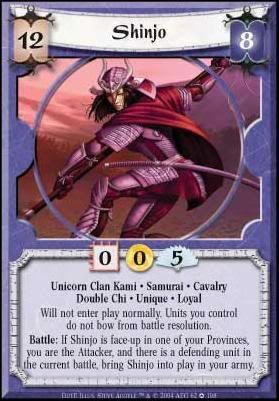
In time, Lady Sun bore her husband nine children, whom they called the Kami. These children were all gods and goddesses like their parents. Doji was the most beautiful of them all. Akodo was the bravest. Hida was the strongest, and Shinjo the quickest. The twins, Shiba and Bayushi, were the most cunning, but Togashi was the wisest and Ryoshun was the most patient. Hantei was the most beloved by his mother. Fu Leng, who had a different name in that time, had almost all the virtues of his siblings. He was almost as clever as Bayushi and Shiba, almost as strong as Hida even though he was small, almost as swift as Shinjo, almost as beautiful as Doji. Only Akodo’s courage and Ryoshun’s patience did Fu Leng lack in any noticeable measure. But while he had many admirable qualities… Fu Leng excelled at nothing. Fu Leng was indolent. His parents were gods — why should he exert himself? Yet each time his brothers and sisters accomplished some great deed and won their parents’ acknowledgment, Fu Leng’s heart burned with jealousy.
All the while, Lord Moon secretly feared his children; in his madness he believed that one day they would destroy him, that they would recreate the world that had already been rendered perfect by his will. Lord Moon’s children were no fools, and some among them sensed their father’s hatred. Bayushi and Shiba feared that one day their father might harm them, but they knew that they alone could not stop Onnotangu — they were only children, after all. They turned instead to Hantei and Fu Leng. Hantei was outraged to hear that his brothers were plotting against their father. He commanded them to abandon their foolish plans, though for love of them he would not tell his father what his brothers had done if they promised to serve Onnotangu loyally henceforth. Bayushi and Shiba agreed.
Fu Leng was not so forgiving. Fu Leng imagined that Onnotangu had loved Hantei best. Perhaps if Onnotangu knew that Bayushi and Shiba had plotted against him, and that Hantei knew the truth but had concealed it, then his father would come to realize that Fu Leng was truly the most worthy of his heirs. Fu Leng promised Bayushi, Shiba, and Hantei that he would speak no word of what had happened… then immediately went to their father and revealed all of what had occurred.
To Fu Leng’s chagrin he was not pleased by his son’s dedication; neither was he grateful. Onnotangu began a savage hunt through the Celestial Heavens, seeking out each of his children and consuming them completely. Even Fu Leng could not hide from his father, and in time he too was swallowed. Lady Sun was horrified by her husband’s actions, but she did not panic. She, too, had sensed the strength that lay within their children, but that strength had filled her with pride rather than paranoia. One day her children might be strong enough to face their father, but that day would not be today.
Playing the part of the dutiful wife, Amaterasu delivered sake to her husband, one cup after each child. Into each cup she let a drop of poison fall. Poison could not kill Lord Onnotangu, but by the time he sought out his last child he was so drunk that he mistook a stone for Hantei, and swallowed it whole. Hantei fled across the Heavens and into the Realm of Dream where his father would not find him.
Each day, after her course across the heavens was complete, Amaterasu visited her son. She taught him to be noble, pure, and brave. She instructed him in the ways of the warrior. She told him stories of the man his father had once been, a noble guardian, a protector of virtue, a creator of the world. While she knew that Hantei would have to face his father one day, she urged him not to hate Onnotangu. For Hantei, this was a difficult lesson to learn, but he accepted his mother’s teachings with duty and sincerity.
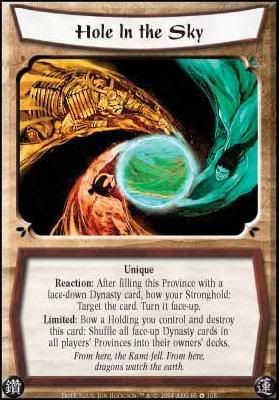
When Hantei was ready, he confronted his father once more. Blades were drawn, and father and son entered a mighty duel that shook the heavens. Onnotangu fought without mercy, seeking to destroy his upstart child, but Hantei could not bring himself to kill his father. In the end, this was his defeat, and Hantei fell before Lord Moon. Yet as his father lifted his sword for the killing stroke, Hantei heard a distant cry, the voices of his siblings. The thought that his brothers and sisters might yet live filled Hantei with hope and strength. He rolled aside as his father’s blade fell with such force that it knocked a hole in the sky. Hantei lifted his own sword and cut his father across the stomach. Lord Moon cried out, such a cry of pain as has never been heard again. His blood and entrails poured forth through the hole in the sky, carrying with them the Kami he had swallowed so long ago.
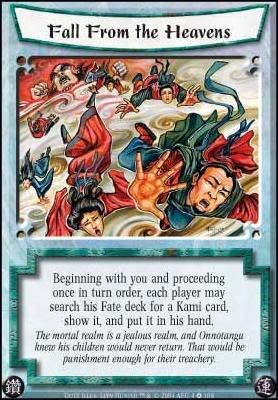
Fu Leng was the last to fall, and as he fell he grasped the edge of the hole in the sky. He looked down at the world below him, the mortal world, and was filled with terror. He could sense something there, something waiting for him, a terror that could not be named. Desperately, Fu Leng reached for his father. Onnotangu took Fu Leng’s hand, crushing it in a vice-like grip. Seeing his brother’s pain, Hantei struck out with his sword again, cutting off his father’s hand. Fu Leng began to fall, but as he fell he seized his brother by the shoulder. Still off balance from the battle, Hantei fell along with his brother.
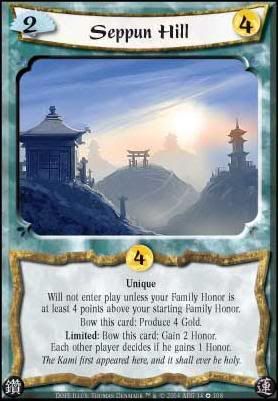
They all fell, down, down, down to the world below. Fu Leng fell further than most; he fell to a place that had been waiting for one such as him. Ryoshun somehow did not reach the earth at all but instead quietly passed into the Realm of the Dead, where he still waits today. The others all fell in a place the mortals called Seppun Hill.
Hantei soon realized that this world had changed them. His body no longer shone with the brilliance of the Heavens. He could feel the weight of time now pressing upon him. He had become mortal. For a time, he sought a means by which to return to the Heavens, but no such path existed. This world was not a perfect world. It was a world of pain and dirt and toil, inhabited by primitive creatures that fought among themselves like animals. When Hantei realized that the heavens were closed, he sent out for his siblings to determine what must be done. What was to become of gods trapped in an imperfect, barbaric world? Was this to be his punishment for betraying and injuring his father?
It was Lady Doji who answered first. “We must follow the example of our mother and father,” she replied. “As the Sun and Moon gave shape to the formless, so must we create order from chaos. These mortals are not without worth, merely without direction. We must offer them that direction, Hantei. We must lead them.”
Hantei was touched by his sister’s words, as were the others. Together they would create a harmony on earth that matched the harmony their parents had created in the heavens, and it would be named Rokugan. But who among them would lead? The Kami conspired to create a grand tournament, a competition of strength, skill, and wisdom that would determine the most fit among them. Each would stand until defeated, and the winner would be named Emperor of Rokugan.
Hida was the first to fall, his strength overcome by Shinjo’s speed. She was in turn tricked by Bayushi, but Bayushi’s twin, Shiba, was too wise and patient to succumb to his brother’s tricks. Doji outmaneuvered Shiba, and was in turn defeated by Akodo who had studied her techniques well. In the end, Akodo faced Hantei; the duel that followed was as incredible a display of determination, power, and swordsmanship that the world has ever seen. Akodo became consumed with the fury of battle, lifting his sword to end his brother’s life. When Akodo thought the battle won, Hantei angled his sword so that the light of the heaven’s shone in his brother’s eye. The light of the heavens flooded into Akodo’s soul, and he realized the horrible deed that had almost been done. He recognized then that Hantei could have defeated him at any time — but he would not shed his brother’s blood. In the face of such strength, compassion, and honor, Akodo realized he was a small man indeed. His sword fell to the earth and he bent his knee before his brother.
Hantei was crowned Emperor of Rokugan before any realized that Togashi had not participated in the tournament at all.
Lady Doji went out to the human leaders, and she delivered them this promise: “We will teach you the ways of the world and we will protect you from its evils. Serve us with humility and obedience and we will keep this promise.”
When the humans heard these words, they were filled with astonishment and dread. Many of the human leaders stepped forward to offer fealty to the Kami. Some, such as Akodo and Bayushi, had already been gathering followers among the mortals. Before long, each of the Kami had many followers to call their own, but imposing their will upon the people was not an easy task. Some did not wish to be led. Some did not desire a path of honor and duty. Some were simply afraid.
Some humans drew sword against the Kami, swearing to purge their influence from the earth. Akodo’s armies purged them from the lands, though he took no joy in their defeat. Others refused to obey Hantei’s will, but did not wish to fight their fellow man. Hantei issued an edict — those who would not obey the Emperor would not live beneath his protection. These renegades journeyed north into the mountains, where they became the Yobanjin, or southwest into the dark plains where the Nezumi once dwelled — and were seen no more.
The birth of Rokugan was not an easy time, but in the end there was peace. Each of the Kami came to serve a clan, and each of these clans swore its fealty to Hantei. Lady Doji became the founder of the Crane Clan, and her followers created art and culture. Lord Akodo became the founder of the Lion Clan; his followers were warriors and it became their first duty to purge all those who would not obey the Hantei’s rule. The twins, Shiba and Bayushi, became the lords of the Phoenix and Scorpion clans respectively, one the master of knowledge and the other the master of secrets. Lady Shinjo, now leader of the Ki-Rin Clan, guarded the Empire’s northwest border, while Lord Hida and his newly founded Crab Clan guarded the south. Lord Togashi accepted no duty from his brother and was given none, nor did he seek followers. He merely retreated into the mountains, where inevitably those who sought his unmatched wisdom came to him.
So ends this part of the tale, yet like all endings this is merely a beginning…
“The Hantei’s Empire grew,” Unmei said. “Each of the Kami sought their purpose and sought their followers in their own way. Some were discovered in the most unlikely places.”
 The Daughter
Takashi landed on the branch next to his brother and perched, folding his arms under his wings for warmth. The spring thaw was coming, but not quickly enough for the kenku’s liking. Takashi absently brushed snow out of his gray feathers with his beak. “What is so important,” he asked, clearly annoyed, “that I must leave our warm home?”
“That,” Mukashi said, pointing down from their high perch towards a human village. The settlement was no more than a dozen buildings haphazardly scattered around what was most likely a water source. Men and woman tended to a herd of livestock here and there, and smoke billowed up from the houses.
“Humans,” the gray kenku said, his mood not improving. “Yes, very interesting. I am quite sure they all have some sort of interesting life story, and you could point out some detail to tell them apart from one another. I have no time for your games, brother.”
Mukashi gave his brother a meaningful look and motioned again with his black talons. “Look there, brother. That building with the two horses outside. That is the headman’s house.”
Though he did not share his younger brother’s fascination with the humans, Takashi knew that Mukashi was no idiot. If he thought something was worth special attention, the older kenku would listen to him. “The headman is the human that the other humans answer to, yes?” he asked, vaguely remembering one of his brother’s endless dialogues about human culture. “Or is that the Emperor? I forget.”
“Never mind, just watch,” the younger kenku replied absently, not taking his eyes from the house. “Look as they come out. See how sad they are?”
As if on cue, two middle-aged humans emerged from the house — one man and one woman. Though they were quite a ways off, the kenku had amazing vision and both could see that the humans were upset. The woman was in tears, leaning against the man, who echoed the woman’s sadness with his eyes. The headman shouted something in the gibbering language of the humans, and two others approached to respond.
“What are they saying, Mukashi?” the older kenku asked.
“The headman’s daughter was lost in the snow and search parties were sent out. He wants to know what they found.”
Takashi found himself becoming strangely interested in the humans. “What did they find?”
“Nothing,” Mukashi said. “The child has been lost for a week. There is no reason to think they will find anything.”
“Have you brought me here to learn pity for these creatures, brother?” Takashi said. The kenku’s black eyes clouded somewhat as he watched the spectacle. “I must confess that it’s working. Shall we find the girl, then?” Mukashi shook his head. “I found her this morning… it is too late for her.”
“How terrible,” Takashi replied.
“Perhaps not,” Makashi answered. He brought one hand out from under his wing and opened his palm. Against the kenku’s black feathers, it was nearly impossible to see the inky substance that hovered in his hand like smoke.
“What… what is that?” Takashi asked.
“It is a piece of Nothing,” the younger one replied. “A small piece of the Universe that Lady Sun and Lord Moon did not name. It is formless, and thus can be shaped by those who have the power. It came to me because it was afraid.”
Takashi didn’t bother to ask if his brother held such power. Though they were relatively young among their race, Mukashi was one of the most gifted kenku mystics in generations. “What will you do with it, then?”
“Left to its own devices, it could be dangerous,” Mukashi said. “Yet if we give it what it seeks… a place in the universe… perhaps we can replace what has been lost, my brother.” The younger kenku looked back to the grieving humans. “We promised not to interfere directly with them, but can we not correct something that has gone wrong? Let me have this one indulgence, brother, and I promise to leave them alone forever.”
The gray kenku looked into his brother’s eyes, then back towards the village, where the human woman had run into her house, wailing in despair at the messenger’s words.
The next day…
“We have found her, Ito-sama!” one of the peasants cried, running into the village with the young girl in his arms. Townsfolk emerged from their buildings at the sound of the man’s shouts. The peasant ran up to the headman’s door and nearly collapsed in exhaustion as he gently set the girl down. The headman’s daughter had dark rings under her eyes, dirt and leaves were caked on her clothes and hair, and her hands were scratched and raw.
Ito, the village headman, came out and quickly gathered up his daughter in his arms, laughing in joy. “Shuro-hime!” he cried, holding his daughter aloft and nearly dancing about in front of everyone.
At the edge of the village, behind a bush, a small girl who looked remarkably like Shuro watched from her hiding place. A great black bird had placed her at the forest’s edge not far from the village and told her to hurry home to her father, the headman of the nearby village. Though her memories were not quite clear, she felt as if this was where she was supposed to be. The man they called Ito seemed like her father, but obviously she was not the girl that had gone missing.
I’m lost, she thought to herself. And this is not my home. The small nameless girl thought about going into the village and seeking shelter there, but something seemed wrong. She did not belong here. A moment ago, she had felt complete and safe once again, but that feeling had vanished at the sight of the man holding the dirty little girl.
“I’ll find my father,” she said to herself, gathering all the courage she could find in her little soul, “and when I do, he will welcome me with just as much happiness.”
Ten years later…
“I thought she was a stable boy,” Bayushi said, continuing with his story as he poured his brother another cup of sake. The First Scorpion’s smile was broad as he recounted the tale, and the woman sitting next to him mirrored her master’s expression. “I thought I had seen everything these humans could do, Shiba, but I tell you… perhaps you and Togashi are right. They are quite remarkable.” The chamber was well lit, though the long table and countless lamps were host only to the three of them: Bayushi, Shiba, and Bayushi’s first vassal, Shosuro.
Shosuro had long ago grown accustomed to the game Bayushi played with his kin. In front of the other Kami, she was an amusement to be discussed as if she were not in the room. After all, what were mortals when sitting between two of the children of Sun and Moon? Away from his siblings, he was a different man. Honest. Open. Troubled. Though Shiba and Bayushi were twins, Shosuro saw what the First Scorpion’s brother did not — her lord was turning over some problem in his mind.
“Imagine my surprise when she was holding a knife to my throat in the geisha house later that same evening,” Bayushi chuckled before he took another drink. His trademark mask lay on the table between him and his brother. He had taken to removing it in Shiba’s presence, in deference to the brother who had defeated him in the Kami’s tournament.
“Indeed,” was all Shiba replied as his dark eyes once again bored into Shosuro. The young woman may have understood the Phoenix Kami’s brother better than he, but Shiba almost immediately seemed aware that something was different about her. He did not give Shosuro the same longing or lustful looks she had grown used to from men — instead he looked at her like a scholar would stare at a particularly interesting scroll, as if pondering a deeper meaning. “How clever must she be to fool even you, brother. I remember when Doji thought to outsmart you during Hantei’s coronation, but not even her agile mind could outmaneuver you.”
“She is a rarity,” Bayushi agreed, his tone losing some of its amusement. He looked back to her, and for the first time, he gazed upon her with open admiration in front of one of his siblings. “A unique treasure, Shiba. I don’t believe we will ever see her like again among her kind.” The First Scorpion gave his brother a meaningful stare before reassuming his ever-present smirk and taking another sip of his drink.
After a long silence, Shiba finally looked away from Shosuro. “I believe you are right, brother,” he answered. “She is a wonder among her people.”
Shosuro tensed as she felt Bayushi’s heart sink. Though the Scorpion Kami’s eyes nor face betrayed his feelings, the bond between them was deep enough that not even Bayushi could conceal from Shosuro his reaction to Shiba’s words. Something had passed between the twins that she could not see. Bayushi knew some truth about her now, something that Shiba had seen and she herself perhaps did not know. It was an uncomfortable thought. Prying secrets from Bayushi was a difficult task, even for her.
The night wore on, and the brothers exchanged stories of the humans and of their home far from the mortal world. Shosuro could not help but feel more and more alone with each passing breath.
“We will find an answer,” Bayushi promised as they rode away from Shiba’s home. “I swear it.”
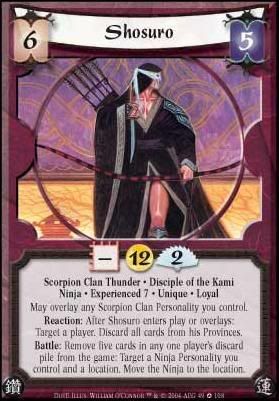
Shosuro only nodded in silence. Bayushi had made the same vow a year ago, some time after they had met. She had showed her lord how she could shift her appearance, allowing her to appear older, younger, taller, shorter, or even like a stable boy. She had hoped the wise and powerful Kami would know why she had never met another human that could do such a thing, but he did not. She had long hidden her gift for fear that it was a sign that she was touched by some demon. Now she was beginning to wonder if she was right.
The Kami sensed his companion’s dark mood. “I recall when you met Hantei,” Bayushi began, attempting to lift her spirits. “He remarked how much you reminded him of our sister, Doji.”
Though Shosuro appreciated what her lord was trying to do, she was not in the mood for another of his games. “That was because I chose to look much like Doji, if you recall. You told me how much the new Emperor favored her, and I thought it would serve us both well to do such a thing.”
“I knew then you had not come to me as some accident,” Bayushi said. “We are different, you and I.” He motioned vaguely to the south, towards the rest of the Empire. “Historians will some day write great tales of Akodo’s bravery and Doji’s charm, while we, who lurk in shadows, will be the villains in their stories. Tricksters and liars: those will be our roles.” The mirth in his words was reflected in his eyes. “Is that not exciting?”
“Are you so certain your deeds will even be worth mentioning besides such legendary figures as your siblings, dear Bayushi?” Shosuro asked as innocently as she could.
Bayushi smiled under his mask and shrugged. “I’ll never be stronger than Hida, nor smarter than Shiba, I think. So why bother?” He sighed dramatically. “They can do what I cannot do. All that is left is for me to do what they would not do.”
“Ah,” Shosuro replied, not yet convinced. “You paint such an enticing future, Bayushi. I wonder if it’s not too late to cast my lot with Shinjo and get lost on a horse somewhere.”
“I think you make a much better villain than a horseman,” the First Scorpion said, his tone slightly more serious. “Do you not?”
After a moment, Shosuro could not help but grin. No one knew her as well as Bayushi did, and being reminded of that always made her smile. Her nature might remain a mystery, but so long as she was beside him, she would never truly be alone.
Bayushi opened his mouth to say something again, but stopped as he felt a familiar presence in the area. He stopped his horse, and Shosuro gave him a questioning look. “It’s nothing,” he said, waving her on. “Keep going.” She did not appear convinced, but knew when Bayushi expected obedience.
After Shosuro had moved a small distance away, she dropped off her horse and skulked back through the shadows toward him, watching and listening. Bayushi looked over his shoulder and grumbled, “What do you want?”
Behind him, in the tall grass of the plains, the strong figure of Togashi stood with his arms folded. He said nothing, though Bayushi seemed to hear something.
“Do you have to do that, brother?” Bayushi asked, sighing as he dismounted. “Why do you not speak like normal people? I’m sure Shosuro is spying on us anyway. Why be so rude as to exclude her from the conversation?” He gave his brother a withering glare. Of all his siblings, Shosuro liked Togashi the least. Even Hida and Akodo were not as irritating as the First Dragon.
Togashi only replied by inclining his head toward Shosuro.
Bayushi turned back around to see that she crouched among the shadows. She rose, looking embarrassed. “Is this necessary?” Bayushi asked his brother, regarding him once again.
You must leave her to her own path. Now she could hear him as well.
“She needs me,” Bayushi hissed in response, discarding all semblance of etiquette. “What do you know of it, brother? What would you know of a bond two people can share? You know nothing.” His voice rose in anger, and he nearly began shouting. “You know nothing. Do you think I don’t know you, Togashi? You watch from a distance, thinking you see everything from your lofty view, but you see only shapes, not details. You know nothing. You feel nothing.”
I will show you what I have seen, brother, Togashi said. This time Shosuro did not share in Togashi’s communication. After a long moment, Bayushi closed his eyes. Now do you see? No matter what you do, Bayushi, she will always be alone.
”No,” Bayushi whispered. He opened his eyes to look at Togashi. “I deny this destiny.” The Kami laughed bitterly. “You see only the future that might be, Togashi. This is not set in stone. So long as I remain beside her, this will not occur.”
Then see that you do so, or I will be forced to take a hand.
The First Scorpion snorted. “I do not need your threats nor your permission, brother,” he said, glancing back to Shosuro. She looked up at him with a faint smile, then looked back at Togashi. He was already gone.
“Something is wrong,” Shosuro said quietly. “Tell me the problem.”
“Nothing is the problem,” Bayushi replied reflexively, and she sensed that he was telling the truth. “Togashi is merely paranoid. It is as I said: we are destined to be villains, and my honorable brother has concerns regarding our future. But we shall be fine, so long as we always remain together.”
The young woman smiled and nodded. “Of course, my lord. And I will always be there.”
“Always?”
“Always.”
“You are a miraculous creature,” Kaimetsu-Uo observed. “I have never seen anything such as you in all my travels. Are there others like you?”
“Many,” Unmei replied.
“And do the Great Clans know of you?”
The koumori shook its head sadly. “They do, but we conceal ourselves from them. Not all are as understanding or forgiving as your grandfather. There was a time when, fearful of Fu Leng’s power, Hantei declared that all creatures not of human origin be destroyed… and Lord Akodo was always first to enforce Hantei’s commands.”
 Glorious Battle
In the instant before his spear plunged into the beast’s heart, Mirotai met the creature’s eyes. It was the first time he had ever truly looked at one of the kitsu; he had spared them only baleful panicked glances during battle. The creature’s red-gold eyes seemed depthless, eternal. In the moment before its death, it revealed to Mirotai the true measure of its soul, and he knew that what he had destroyed was no mindless beast. All this passed through his mind in the span of a heartbeat. He envisioned the lands beyond the mortal realm, countless spirit realms that spiraled out in every direction. Then there was a shudder at his shoulder as the spear struck home, and the beast was dead.
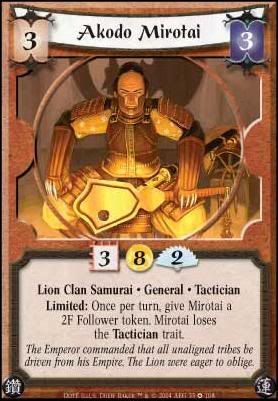
All the strength drained from Mirotai’s limbs. He released the spear and slumped to the ground, the cloth at his knees tearing as he collapsed onto the jagged stones of the mountain path. The light he had seen only moments before in the kitsu’s eyes was gone, and the brilliant golden fur that had seemed to shine like the sun was now dull brown, somehow cold to look upon.
“What have I done?” he whispered.
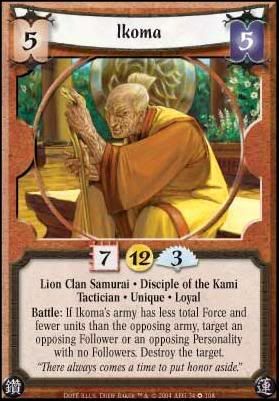
“Your duty,” came the answer. Rough hands grabbed Mirotai’s elbow and pulled him to his feet, clapping him sharply on the back in a brotherly fashion. “Well done! Are you hurt?” Ikoma grinned broadly at the young warrior, the scarred old man strangely out of place in his shining golden armor. “No, nothing wrong with you a good bottle of sake cannot fix! The finest gift of the Kami, sake. I bless Lord Hida with every cup I drink, and curse him when I awaken the next morning.”
Mirotai shook his head, unable to speak. He brushed at his clothes absently, glancing around the mountain pass to survey the aftermath. The great Akodo had gathered two dozen of his finest warriors to scour the hated kitsu from the mountains. In the Champion’s final stop before entering the mountains, three of Akodo’s men had been stricken with a terrible fever. Unwilling to wait, the Kami had replaced them with three soldiers from the village’s meager garrison. Mirotai was among them. He had felt at once greatly honored and completely terrified.
“Well done, brothers.” The voice boomed across the mountaintop like thunder. Akodo moved through the ranks, speaking to each of his men in turn. He came to stand before Mirotai, his armor gleaming in the midday sun.
“How fares our new recruit, Ikoma?”
“Very well, great Akodo-sama,” the old warrior replied. “Mirotai claimed one of the beasts in single combat.” He gestured to the fallen beast, still impaled on the spear. “No mean feat for one so inexperienced, wouldn’t you say?”
“Magnificent,” Akodo replied with a nod. “A rare honor indeed, Mirotai. It grows more difficult to find these accursed creatures, and even more difficult to kill them. Our hunts take longer each time, with few sightings and even fewer kills. Soon our task will be finished, and you will be numbered among the fortunate few Ikoma will speak of as the kitsu slayers.”
“The stories will mostly be about me,” Ikoma said in a confidential tone. “It helps weaken the resolve of women, you understand.” He paused for a lecherous grin. “I’m sure I can find time to mention how you assisted me in our glorious battle, young Mirotai. Maybe there’ll be a few ugly sisters left for you when I’m done.”
Mirotai nodded mutely. Ikoma was… not what he had expected. The tales his people told of Akodo, on the other hand, made him seem to be a giant among men, a god that walked the earth. Yet Mirotai was not a large man, and Akodo stood no taller than he. He was muscular, but not remarkably so. His only truly distinguishing physical characteristics were his eyes, which burned with an unmatched passion. Other than that, he could have been any mortal man that one might encounter in a teahouse, or working a farm in the countryside.
Despite his appearance, there was no chance that Akodo would be mistaken for a mere mortal. There was something about him, something that Mirotai could not identify, that set him apart. The air around the Champion seemed strangely electrified, like the air after a lightning strike. The ferocity in his eyes was contagious. Already, Mirotai wondered if what he had seen with the kitsu had been a trick of the mind. In the presence of Akodo, there could be no uncertainty. His presence destroyed doubt and fear.
“My scouts have picked up a trail to the northeast,” Akodo said. “We will pursue them, but first we must return to the village for supplies and to treat our wounded.” He gestured to the fallen kitsu. “You will stand at my side during the hunt, Mirotai.” He raised an eyebrow and smiled. “Although you’ll need a new spear.”
“Also sake,” Ikoma insisted. “Much more sake. And if Mirotai desires none I claim his share. Now, Mirotai, tell me about the women in your village.”
That night the village celebrated. Its people had lived in fear of the kitsu, and news of Akodo’s successful hunt was met with joyful relief. Mirotai found himself something of a hero among his friends and family, and was constantly asked to recount his experience. After the fourth such request, he had shouted angrily at one of his cousins in the public square, eager to separate himself from praise he felt he did not deserve. That had ended his newfound fame.
Later in the evening, Mirotai found himself a shadowed corner table in his favorite sake house. News of his poor disposition had already spread throughout the village, so the other patrons were happy to give him his space. There were a few of Akodo’s soldiers here, but most had gone to the livelier house down the street. Things were mostly quiet, which is exactly what Mirotai needed. When Akodo sat down at his table, the young samurai was caught completely off-guard.
“How is the sake here?” the Kami asked.
Mirotai blinked in surprise. “Uh, I like it,” he stammered.
“Good enough,” Akodo responded, pouring a cup. He savored the warm liquid for a moment, nodding appreciatively. “My brother is a madman for creating this. So, are you prepared for tomorrow?”
“I do not know,” Mirotai replied honestly. “I only hope I will not disappoint you, my lord.”
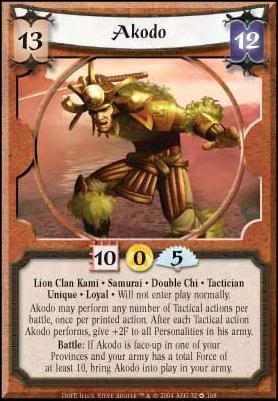
Akodo waved the comment away. “Do not fret over such things. I would leave you here if I did not believe you would be true to your clan.” The Champion seemed distracted, glancing around the sake house with a wistful expression. For the first time, Mirotai wondered about the beauty and majesty the man must have been accustomed to in the Celestial Heavens. How could anything in the mortal world possibly compare? This life must be dull and colorless by comparison. He thought again of the visions he experienced when the kitsu died. The hunt, perhaps, was one of the few things that could make such a man truly feel alive again. Absurdly, Mirotai felt a swell of pity for one of the most powerful beings in Rokugan.
“I will be ready, Akodo-sama,” Mirotai said.
“Akodo!” came a rough voice across the sake house. Ikoma came through the door, a mostly empty bottle of sake in his hand. His eyes were alight with the evening’s enjoyments. “The men are looking for you! You should probably say something inspirational to prepare them for the morning. Some damned fool got them all riled up and the sake is flowing far too freely.” He smiled and hid the bottle behind his back. “I have no idea who might be responsible.”
Akodo shook his head with a quiet chuckle. “I will see you in the morning, Mirotai.” When the Lion Champion left, Ikoma appeared at the table to take his place.
“There is a serving girl at the house down the street,” he said with a leer as he took the mostly full bottle Akodo had left. “She has the most unbelievable… er, you don’t have any relatives who work there, do you?”
Mirotai shook his head absently, causing Ikoma’s dead eye to narrow. “You’re thinking about the beast you killed again. Let me give you a bit of advice, boy. Don’t. I’ve sensed a power within those kitsu as well. I’m not sure what it is… but we’re probably better off without it.”
The young man looked up in surprise at the harsh tone. “This is a war,” Ikoma continued in an ominous tone. “We may call it a hunt, but it’s war. Every day is a war. You fight against something, anything. Maybe it’s sickness, maybe it’s an enemy. Maybe it’s even a storm or some bizarre lion-spirit, but it’s something.” He leaned in closer. “You do whatever you have to do to win. Honor is a pretty word, but it won’t save your life. I’m an old man, boy, and I got to be an old man by doing whatever it takes to survive. You’d better learn to do the same, or else your parting glance at the village in the morning could be the last time you ever see it.”
Again, Mirotai could only nod, even though in his heart he did not agree.
The Lion found the kitsu on the morning of the tenth day. The beasts had retreated to a small plateau amidst the peaks. Caves in the mountaintops provided plentiful lairs. Even at a glance, Mirotai realized that the creatures far outnumbered Akodo’s men. Even as the thought filled him with fear, he thought back to the creature he had slain only a short time ago. If these were the last of their kind, then he could not help but regret his role in destroying something so majestic.
Akodo seemed elated to have discovered his prey at last. He ordered his men into small squads and moved them to the most convenient points of entry to the plateau, preventing any chance of escape. When they all had ample time to reach their positions, Akodo drew his blade and shouted the signal to attack.
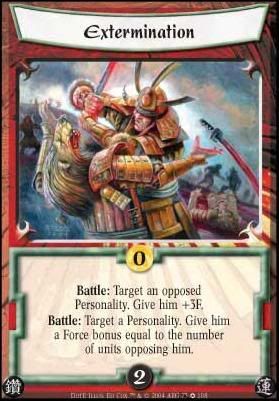
The Lion samurai charged into the kitsu’s midst from all directions, their fierce cries disorienting the huge creatures. Even as he ran at Akodo’s side, Mirotai marveled at how much larger these creatures were than the one he had slain.
“There!” Akodo shouted, pointing with his blade. Across the plateau, a kitsu of truly incredible size stood near the mouth of a cave. As they watched, a samurai charged the beast, only to be knocked away with a single blow from the back of the creature’s massive paw. The warrior was not killed, but the sharp impact from the blow left him writhing in pain in the dirt, removed from the battle for at least a short time.
The Lion Champion cut one of the creatures in half with his blade, pressing forward toward the largest one. “Mirotai, attack its flank!” he commanded. Mirotai moved to obey, his spear at the ready in case the beast leapt upon him. The kitsu turned to face him for a moment, fixing the young samurai with its large, red-golden eyes. For a moment, he saw in it the same intelligence the other had possessed, the same depthless understanding of the universe, only laced with anger, sadness, and hatred. This time he saw even more. He saw a time before, when the kitsu ruled these lands. He saw them face an enemy similar to the Dark God that had arisen in the south. He saw them win, but only at great cost. He saw their race recede, slowly die out, only to be further decimated by Akodo’s noble attempt to serve his brother. The creature turned back to Akodo.
“Now, Mirotai! Now!” Akodo shouted.
Mirotai took a step forward, then stopped. He felt the spear drop from his hand to lie useless in the dirt. “I cannot, lord Akodo. I am sorry.”
“What treachery is this?” Akodo demanded, his voice even and calm.
The beast itself retreated, offering Mirotai an appraising look. It glanced from him to his lord.
“Look in its eyes,” Mirotai offered. “I cannot kill this creature. It is not for the likes of me to end its life.”
Akodo said nothing, his face fixed in a fearsome scowl. He sheathed his blade and leapt upon the creature with a speed that Mirotai had never seen in any living creature. The two grappled for a moment, and the sheer power of their mutual struggle was such that all other combatants moved away for fear of being crushed by the struggle of titans. With a roar that split the heavens, the kitsu hurled Akodo away, leaving the Kami in the dirt.
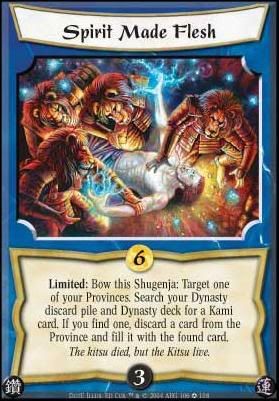
Acting on instinct, Mirotai snatched up his spear and took a step forward. He would not stand by while his lord perished, no matter how blasphemous violence against these creatures might seem. He would not abandon Akodo.
The kitsu stood silently, regarding Akodo with obvious hatred. The Lion Champion remained motionless in the dirt for a long moment, staring at the huge beast in surprise — and with a dawning horror that Mirotai recognized.
“Stand down!” Akodo shouted as he rose to his feet. The clamor all around the plateau died down as both kitsu and samurai ceased their battle. Akodo regarded the large kitsu for several tense minutes, and then, amazingly, bowed low before it. Even more amazingly, the beast lowered its head in a similar show of respect.
Akodo’s expression was grim. He glanced around, his eyes settling on the nearby Mirotai. “I have been a fool,” he said blankly. “In my lust for the hunt, I have been a fool. These creatures are not of Fu Leng. They merely did not know how to speak to us. In my quest to serve my brother’s will, I may have destroyed our greatest allies.”
“What will we do, my lord?” asked Mirotai.
“We will make amends,” Akodo replied. The Lord of Lions turned and looked again into the creature’s eyes.
“These tales are dark and terrible,” Kaimetsu-Uo said morosely. “Was my grandfather’s time truly so bleak? Did Fu Leng’s rise to power overshadow everything?”
“No,” Unmei replied with a smile. “Not everything.”
 The Perfect Gift
The young samurai stopped for a moment to rest. Wiping his brow with the sleeve of his kimono, he withdrew a rice ball from his travel pack and munched on it noisily. After weeks of travel, he was beginning to have second thoughts about his purpose here. If he centered his thoughts on his goal, then he could keep his will focused and his mind clear. When he considered the enormity of the questions he must answer, however, he began to grow frustrated by the task set before him.

Ironically, he had no one to blame but himself. He had always been the most talented member of his village, with a quick wit, a ready sword arm, and a dashing smile that could melt the coldest heart. He had felt so certain of his gifts that he had dared travel to the distant realm of Otosan Uchi and competed in the Emperor’s tournament. Against all odds, he had emerged victorious. He was surprised, truth be told. He only wanted to test his strength; he did not expect to become the Emperor’s Champion. On that day, his life became difficult, and not merely due to his new title.
On that day, he met the Lady Doji.
Six months ago…
The fields outside Otosan Uchi were filled with spectators and participants. The city had been completed at long last, and the Emperor had declared a great celebration. Subjects traveled from all across Rokugan to enjoy the revelry. Many came to participate in the trials of strength and skill that the Emperor had sponsored. All of Hantei’s brothers and sisters were present, accompanied by their finest warriors, poets, and craftsmen. The revelry had gone on for days, and showed no signs of winding down.
The young samurai sat apart, quietly cleaning his blade. He had barely spoken to anyone since his arrival. He had little to say. Others mistook his silence for arrogance, but in truth he had little idea what to say. He had lived his entire life in Rokugan’s distant northern provinces, and Otosan Uchi had overwhelmed him. He refrained from speaking partly because he was afraid of saying something foolish, and partly because he wished to preserve his focus.
Focus. That was the key. With a clear mind focused properly on an opponent, it was possible to witness every second as if it were a lifetime. One could view every tiny movement, every twitching muscle. It was this focus, and the ability to react to it as rapidly as the beat of a hummingbird’s wing, that made up the art of Iaijutsu – his art. Already, he had defeated representatives from the Ki-Rin and Scorpion clans, and a handful of men like himself who owed allegiance to no lord. Now the final match approached, the match he had been preparing himself for all day.
Lady Matsu, called by some the Lady of Lions.
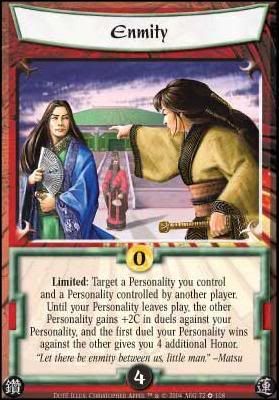
He assumed his stance, as did Matsu. He settled into his focus, fixing her with a pleasant smile, holding one hand above the hilt of his sword as if offering a gift. The mocking pose drew her out. She lunged forward with the same rage and relentless assault that had brought her victory over more than a dozen opponents thus far. She was accustomed to her opponents succumbing to fear, and rightfully so. But this samurai was like no opponent Matsu had ever faced.
He stepped forward, inside her strike, catching Matsu off guard. With a precise strike, he drew his blade and knocked the weapon from her hand. A quick follow-up knocked her to the ground as well, and his blade was at her throat in an instant. The hatred in her eyes was unmistakable, and in that instant the duelist knew he had made an enemy for life.
The Emperor rose from his seat in his private box, a smile on his face. “My congratulations,” he said.
The duelist withdrew his blade and bowed deeply before the Emperor, though his eyes wandered to the lovely woman that stood beside Hantei. She wore robes of the palest blue, and smiled faintly at him.
“What is your name, my friend,” Hantei asked, not noticing the boy’s distraction or merely ignoring it, “that I might tell the Empire who my new champion is?”
“I am Kakita, my liege.”
“Hello, sister,” the Emperor smiled warmly. “Thank you for agreeing to see us so quickly. I know your days are busy indeed, perhaps even more so than mine.”
“Do not be foolish, Hantei-sama,” Doji replied demurely as she bowed deeply. “There will never come a time when I am too busy to see my beloved brother.” She smiled coyly. “Or my Emperor.”
“You honor me, as always.” Hantei smiled. “I have brought a friend to meet you, dear sister.” He regarded Kakita with a knowing look, gesturing for him to step forward. Kakita did so on leaden legs. “This is my personal champion, Kakita. He has also become my friend, and it would honor me greatly for you two to marry. It would strengthen your house considerably, Doji-chan.”
Kakita found himself unable to speak. Back at home, he could charm any woman he wished. A number of ladies longed to call him husband, and he could easily bring even the most conservative among them to a scandalous blush with a smile and a turn of his head. But he had never seen a woman like Doji before. The first sight of her at the contest had stunned him, but to see her this closely moved him beyond words.
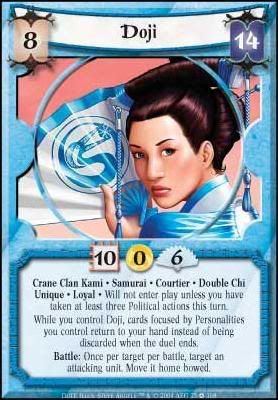
The Lady Doji was the most radiant sight he had ever laid eyes upon. Her hair was like a wave of silken ebony, and her eyes the same color as her silken kimono – the color of heaven. He had come here thinking of a thousand different ways to win Doji’s heart, but he could not think at all in the presence of such beauty.
“K-konichiwa, Doji-sama,” he finally stuttered, kneeling before her.
“My greetings, Kakita-san,” the Crane Kami said with a bemused expression. “I had heard the Emperor would bring you before me with such a proposal.”
“You had?” Kakita asked.
“Indeed,” Hantei said with a curious expression. “There seems to be no end to your resourcefulness, dear sister.”
“You flatter me, Hantei-sama,” Doji said with a slight bow. “I have heard,” she said, turning back to Kakita, “that you are wise and knowledgeable as well as apt with a blade. I would make a request of my betrothed if we are to be married, a contest to prove the worth of my brother’s champion.”
“How intriguing,” Hantei said, smiling broadly. “I approve. I can deny Doji nothing.”
Kakita felt his heart soar. She would agree! “Anything you wish, my lady.”
Doji’s smile grew mischievous. “I have three requests to ask of you.”
“Three requests,” Kakita growled bitterly. “She may as well have asked me to move the sun, moon, and stars from their place in the Heavens.” He sat heavily on a rock overlooking the sea. The demands his bride-to-be had made of him were the type of riddles that wise men contemplated for decades without any hope of resolution. And while Kakita considered himself many things, a wise man was not one of them. Bring the dead to life? Measure the width of the world? Show her a vision? How was he to fulfill such requests?
In frustration, Kakita hurled a stone into the sea. The distant splash was hardly satisfying. He considered trying to hurl the stone on which he sat over the cliff’s edge, with himself on it. He had traveled to this fishing village out of desperation, for he had found nothing in his travels so far. When he described his quest to the villagers, they advised him to consult an old wise woman said to have the gift of foresight. Supposedly she lived by the sea, but thus far Kakita had had no success in locating her. The villagers had seemed unwilling or unable to provide exact directions. Perhaps she was merely another myth to chase fruitlessly.
“Perhaps you are simply not looking in the proper place.”
Kakita was on his feet in less than a second, his blade drawn and at the ready. A young man in fisherman’s clothing stood nearby, his hands folded neatly in his sleeves. How he had approached so silently, Kakita could not imagine. “I do not mean you harm, Kakita-sama,” the young man said. “I was sent by my mother to find you. I am Torikago, son of the wise Yasuki. Will you accompany me?” The young man gestured to a cliff in the distance.
Kakita squinted into the sunset. Atop the cliff was a small hut that he had mistaken for a rock outcropping when he first arrived. Likely he was not the first to make such a mistake. Perhaps that was how the mysterious Yasuki remained hidden from those who sought her wisdom. He sheathed his blade. “I will accompany you, Torikago-san. You have my thanks for your guidance.”
Torikago smiled. “It is my pleasure, Kakita-sama. Or rather, it will be.”
For perhaps the second time in his life, Kakita found that he was nervous. It was an absurd sensation, and one he found that he did not care for. He had always been blessed with certainty, never questioning that his every action would be correct. Doubt was unfamiliar, and he hated it.
“Relax, brother,” Kiyamori told him. “You have prepared for everything. How could she resist you?”
Kakita drew a deep breath. “She is a god,” he replied. “How could she not?” His twin sister had always been the optimistic one in the family.
“She was a god,” Kiyamori replied. “She is mortal now, and I assure you she is a woman like any other.” She glanced over her shoulder to the waiting Torikago. “And if you do not win her heart, then I will have no reason to go through with my marriage.” She leaned in close and smiled coyly. “So do try to do your best, brother.”
Chuckling, Kakita hefted his travel sack and drew a deep breath. With a quick prayer to the Fortunes, he stepped through the doorway into the court chamber of the Emperor’s palace.
The crowd was larger than he had expected. The Emperor was there, of course, along with Lady Doji and many members of her personal entourage, as well as representatives from many other clans. “Kakita-san,” the Emperor said with a smile. “I am glad to see you returned safely from your travels. I trust you were successful?”
“I was, my lord,” Kakita responded. There was a murmur throughout the crowd as they noted the rough traveler’s clothes that Kakita wore, along with the heavy sack that hung at his hip. Lady Doji casually opened her fan to conceal her face. Kakita turned to face his bride-to-be. “My lady, the first of your requests was to bring the dead to life. I found a piece of driftwood upon the seashore, torn long ago from the tree that bore it. From that dead wood, I carved this.” He drew a small stringed instrument from his bag, one that Yasuki had devised and taught him to play. He played a brief piece of music, hauntingly beautiful and inspiring. When he was finished, he offered the biwa to his bride. “I hope that I am not arrogant in believing this wood has returned to life for you, my lady.”
A corner of the Emperor’s mouth quirked upward, and he nodded in approval at his Champion.
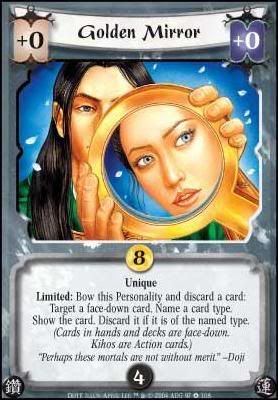
Kakita turned, addressing the crowd along with Doji. “Your second request was that I tell you how wide the world is, and how long it might take to walk across it. From only a moment of your company, I learned that the secret is in companionship, for that is the true measure of any journey.” He smiled. “If I were sufficiently blessed as to consider your mother Amaterasu my companion, then I might cross the span of the world in a single afternoon.”
Behind Doji, Hantei concealed another smile by stroking his chin thoughtfully, but Kakita could see the laughter in his eyes. Was he imagining it, or was Doji blushing behind her fan? He could only hope. “Your final request was both the most difficult and the most fulfilling. You asked for a vision of peerless beauty. I struggled with your request for some time before I realized what I sought was easily found. And thus I have retrieved it for you.” He reached again into his furoshiki and withdrew something, hiding it in his cupped hands. He held it forward to show it to Doji, who leaned forward eagerly to inspect the treasure.
In his hands, Kakita held a small golden mirror that reflected Doji’s own image at her.
The Emperor stood and spread his arms wide. “The wedding of Doji and Kakita shall take place at once. Make ready for the festivities, my friends.” He smiled at the couple. “This shall be an occasion to be remembered always.”
Though the Emperor’s words filled Kakita with pride, it was nothing compared to what he felt when he looked into Doji’s sky blue eyes and saw his love for her returned at last.
“Even though Fu Leng was wicked, there were those who still loved him,” Unmei continued. “Shinjo, most of all, prayed that her brother could be saved. The Clan of the Ki-Rin valued loyalty and unity, virtues that sometimes left them unprepared for the treachery of others…”
 The Hand of Peace
Wind was such a curious thing. On a hilltop near the northern mountains of the fledgling Empire, a woman threaded her fingers through the wind as it passed her by. In her home among the Celestial Heavens, the woman had never felt such a fierce blast of air. There the wind had been a gentle breeze that was never too cool or too warm.
Shinjo was not sure yet if she missed the wind in the Heavens, or preferred the more varied and random winds of Rokugan.
Beside the beautiful Kami, two men stood and awaited the will of their leader. They had been called to meet with Shinjo at dawn, but she had not spoken for hours. The Kami instead seemed as if she were communing with the breeze, sensing it in some way the two mortals could not understand. Out of respect and more than a little fear, both Ide and his student Bairezu waited silently for Shinjo to speak.
Finally, the wind deposited a speck of ash in Shinjo’s palm. Though a normal woman would have never noticed such a thing, to the Kami’s senses the ash was as jarring as a thunderclap on a clear day. Shinjo closed her eyes as if in pain and squeezed her hand around the mote, then lowered her head.
“Fire,” she whispered, causing the two mortal men to start. “From the west and south. The wind carries the smell of war… the screams of the dying…” She opened her hand and let the ash float away on the breeze as she finished, “… and the horrors in its wake.” After a short pause, the Kami turned to Ide and bound her long black hair so that it would not fly free on the wind. “Ide, do you know why I have brought you here?”
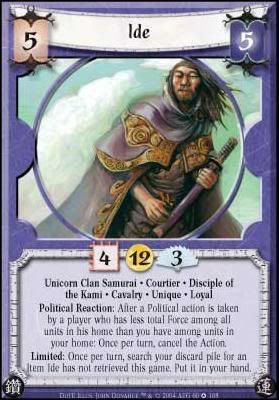
“No, my Lady,” Ide replied, taking a step forward and bowing his head before the Kami. Though he was young, Ide had impressed Shinjo. While many of the other Kami had gathered the strongest warriors of the tribes, Shinjo had favored Ide for his honesty and his cleverness. Shinjo had come to rely on his counsel when it came to dealing with the mortals. Those that feared the otherworldly Kami were often soothed by the kind words of her vassal. Ide’s most promising student and a warrior of no small talent, Bairezu, waited patiently behind him as his superiors spoke.
Shinjo cast her eyes once again to the south and spoke with more steel in her voice. “It is my brother, Fu Leng. We thought he perished as Ryoshun did, but Fu Leng has returned. He has been driven mad somehow. He has pledged to undo everything Hantei has wrought and claim this land for his own. He commands an army of oni from the deepest pits of Jigoku.”
“I have heard of a dark army marching from the south, my Lady,” Ide replied. “I… did not know there was yet another Kami that had come to this land with you.”
“We did not speak of him,” Shinjo said, closing her eyes as if to banish the memory. “But now villages burn at his command and his advance cannot be contained.”
“Shall I send word to Otaku?” Ide asked, motioning back towards where Shinjo’s followers had settled. “Perhaps she would be equal to the task of…” His voice trailed off as he realized what he was about to say.
The Kami completed his thought. “Making war upon my brother?” Shinjo was conflicted — the slaughter had to stop, but could she destroy Fu Leng? What if he could still be saved? “I will decide when that is necessary, Ide,” she nearly growled. Shinjo felt a small pang of remorse for her misdirected anger, but she knew Ide would understand. “No, there is something else you must do for me. Something you must do for so many of us, Ide.”
“Whatever you wish, my Lady,” Ide responded sincerely.
“Are you so sure, Ide? What I ask may cost you your life, and the life of young Bairezu, but we gamble to save the lives of thousands.”
Ide looked a question at his student.
“I would count myself most fortunate if my death were to have such meaning.” Bairezu said, bowing low to the other two.
“We are in agreement, then,” Ide said, then added with a grin, “Though I will do my best to avoid such good fortune if possible.”
“Kill me now,” Ide sighed under his breath as he brushed yet another bead of sweat out of his eyes. He and his student had reached the mountains earlier in the day, though the terrain had only recently grown so rough that they were forced to lead their horses. Ide was not a weak man, but he was unused to prolonged physical exertion. A few hours of negotiating the rocky landscape was proving more daunting than the task Lady Shinjo had set before the two men.
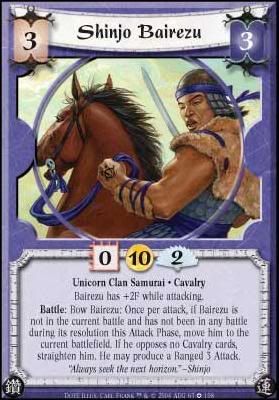
“Praying to the Fortunes for assistance, master?” Bairezu asked from behind Ide. The much younger man had spent his whole life training for war, so the journey had yet to take any noticeable toll on him.
“You might say that,” Ide replied. He turned back to his student and motioned to the path ahead. “You should lead, Bairezu. It did not occur to me until now, but you may be able to find a more… reasonable route through these lands. You are accustomed to such travel, are you not?”
“Hai, master,” the younger man said, “but I fear I would not know which way to lead us. I have never been here before, as these are the lands the great Emperor has given to Shiba and his followers.”
Ide shrugged and looked around, “I’m not following any particular route, my student. Lady Shinjo commanded us to find the tribe of Yobanjin, the ones who chose to live outside the protection of the Kami. All I know is that they are in these mountains. Somewhere.”
Bairezu opened his mouth to speak, but hesitated. After a pause, he said, “May I ask a question, master?”
“Of course,” the older man replied, grateful to postpone further walking.
“Do you think they will return with us?”
Ide took a deep breath and rubbed his chin in thought. After a moment, he said, “I really do not know, Bairezu. But it is Shinjo’s will that the protection of the Kami be offered once again to these people, in light of the new threat that arises from the south.”
“They are a proud people,” Bairezu said, “I do not think they will accept.”
“Then the Fortunes will punish them for their arrogance,” Ide said quietly.
An instant later, a noise pierced the silence of the afternoon, and Ide’s horse reared, an arrow protruding from its neck. Faster than either man could react, the mount was shot twice more, and Bairezu’s steed was dispatched in a similar manner.
Ide reached for the short blade on his obi, and Bairezu drew the heavy katana that his father had given him.
“Throw down your weapons!” a thick voice called from seemingly nowhere, and suddenly several archers grew out of the surrounding terrain. The two vassals of Shinjo were surrounded, and one of the archers advanced on them with his bow drawn. “Do it!” he yelled, hatred plain in his voice and on his face. “Or I will punish you for your arrogance.”
“Are you of the Yobanjin tribe?” Ide asked as he laid his knife on the ground. Beside him, Bairezu glared as he followed his master’s lead. “We have been looking for you.”
“You found us a day ago, with your noisy and smelly march through our lands,” the Yobanjin replied with a sneer.
“We have come to deliver a message from—” Ide began, but was cut off when another shrieking arrow shattered the stones at his feet.
“Silence, fool. We know why you are here. We have been stalking you until our chieftain sent word if we were to kill you or not.”
“From the greeting we just received, I can guess at his choice,” Ide said darkly.
The Yobanjin flashed Ide a smile that held twisted joy. “Ask him yourself,” he said, inclining his head.
Ide and Bairezu turned to see what the archer was indicating, and both men nearly gasped. Against the light of the setting sun, a massive serpentine figure moved between air and ground, approaching at an amazing speed. Within seconds, the flying serpent settled upon the rocks, a massive human on its back.
“The chieftain?” Bairezu asked Ide quietly.
“I think so,” the older man replied, trying his best to keep the sarcasm out of his tone.
“Kneel!” the lead archer commanded as the rider drew nearer. Ide looked back at his captors, still caught off guard by the entire situation. “I said kneel!” he hissed, slamming his elbow into the back of Ide’s head.
Ide crumpled to the ground. Bairezu spun on the leader to attack, but was shot in the leg by another of the tribesmen. The warrior cried out in pain and fell to the ground on one knee.
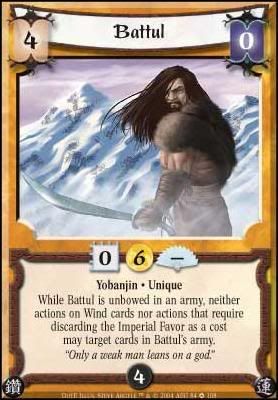
The chieftain dismounted gracefully, mere feet from the two Rokugani. “I see Harito is teaching you dogs some manners,” he growled, looking to the unconscious form of Ide, then to the wounded Bairezu. He seemed completely unconcerned at the state of the two men and leveled his dark gaze at the younger warrior. “You bring a message to the chieftain of the Yobanjin. I am Battul, little one, which means you have a message for me.”
Bairezu focused on the matter at hand, forcing himself to ignore the crippling pain in his leg. “I have no message, mighty chieftain,” he said defiantly. “Ide does. I suppose you will need to wait for him to get back up from your friend’s lesson.”
Battul crossed his massive arms against his chest and smiled thinly. “You Rokugani. So very clever. So civilized,” he said lightly, then delivered a savage kick to Bairezu’s chin, sending the young warrior sprawling backwards onto the ground. “Perhaps you can try and recall what that message may have been.”
“They come from their Kami, one called Shinjo,” said Harito. “I heard them saying they had come to offer us slavery under the Kami’s rule once more.”
“No,” Bairezu said, scrambling to his knees despite the pain. “It is not slavery, and you are blind if you think it is. The Kami are merciful and wise. They seek to protect those around them and build an empire that will flourish for the benefit of all. But one of their number has gone mad and is raging across the countryside unchecked, destroying all his siblings wish to build. He will murder you and your kin if he finds you.”
Battul raised an eyebrow, clearly unimpressed. “You make such an attractive offer. Why should I not wish to serve these slave masters who might… go mad and murder my people? Our kind survived long before they appeared to put us under their yoke. You are young, but your father will tell you we were the strongest of the tribes. Your Shinjo will tell you that Hantei spared our lives, but he knew he could not destroy us. I find it unlikely that we will be unprepared to deal with some wandering madman and his followers. There is nothing we cannot prepare for.”
“Or flee from,” Bairezu spat back. “Is that not how you dealt with Hantei?”
Battul drew a long blade from his belt in a smooth motion and held the edge against the younger man’s neck. “I should kill you for your insolence, worm… but I promised my people we would not war with the Kami or their followers.” The chieftain’s eyes narrowed dangerously as he let a feral grin cross his face. “And if what you say is true, that this army is led by one of their siblings, then I fear my oath prevents me from taking up arms against that one as well.” Battul put his weapon back in his belt and signaled his followers to stand down. “Besides,” he added, climbing back up onto his mount, “why would this enemy come after us? If he seeks only to war against the kingdom of his brothers and sisters, he will have no quarrel with us, and our wyrms fly swiftly.”
“It will not end there,” Bairezu shouted. “Even if the Kami can defeat his armies, what is to say parts of the broken horde will not wander into your territory?”
“There is always new territory to conquer,” Battul said. “Go back to your slavemaster, little one.” His serpent rose lazily into the air, and he turned it back the way he had come. “Tell her never to seek us again, or her messengers will not be as fortunate. Tell her to tell her arrogant brother that he will never command us.” With a nod of respect, the chieftain added quietly, “I respect your bravery, warrior. I wish you luck in finding your way back to your new home. When your side loses, find me again. You have a place among the Yobanjin.”
“Shinsei’s arrival brought answers, but also many more questions — as answers usually do,” Unmei said. “In one case, these questions drove a Kami to seek his place where he had none. While other clans see it as their role to follow a certain path, it is the Dragon’s place to eternally seek a new path.”
 Way of the Dragon
Turn back, Kaiteru. Turn back… your family misses you…
The young man pressed a raw and bleeding palm to his temple as the voices returned. He could not tell if the howling winds of the mountains were playing tricks on him, if the hunger in his stomach was warping his mind, of if there were indeed spirits talking to him and him alone. The stickiness of blood drying on the side of his face did not bother him any more — he had grown used to the unclean feeling some time ago. After he reached the mountains, more and more of his clothing had become bandages for cuts and scrapes inflicted by the climb. Eventually, the rocks had even claimed those, and he was left with little more than torn hakama and his gnarled hair.
“Go away,” Kaiteru whispered to the empty wind as he gripped the mountain with both hands again.
Away? Oh, Kaiteru, away is where you have gone! Away from your mother, away from your sisters. Away from the family that needs you now that your father is dead…
Kaiteru closed his eyes and pulled himself up the mountain face with trembling muscles. The climb seemed much shorter from the base of the range, but he had been climbing for two days and he barely felt as if he were halfway up. “You lie,” he hissed as he moved slowly. “My father is alive.”
Blown away by the winds of war, your father died in Akodo’s army… such a glorious end for a samurai… such a tragic tale for a family. No heirs to the name… a family will die with you…
In his mind, he saw his father holding a mighty sword and standing against countless enemies. His golden armor shone in the sunlight and he seemed like a vengeful spirit sent by the Sun Goddess. Goblins and foul beasts fell before him, but it was clear the man was not an immortal spirit, and he was tiring. Enemies pressed against Kaiteru’s father, drawing closer and closer until finally one struck him savagely in the side. The samurai stumbled for only a moment, but it was all the horde needed to overwhelm him.
“NO!” Kaiteru shouted as the vision played out in his head, and his scream was whipped into nothingness by the howling reply of the mountain winds. “No…” he whispered, choking back tears. “You lie!” he screamed again, glaring out at the empty sky.
The end of a line, the father a hero and the son a coward, run away to the mountains when he could have saved his father. How sad… how sad…you gave up your family, little mountain lion. You gave them up to history.
The young man pressed his body against the mountain face as the wind blew harder and colder with each second. Had he been a coward? Had he failed to be a true samurai like his father had wanted? Had he given up…?
Kaiteru opened his eyes as clarity dawned on him, as it had when he saw the mountains years ago.
“Yes,” he said to the wind. “Yes, I left them, but they were never mine to give up, nor were they mine to save. Their kharma was not mine.” He reached to pull himself up the mountain, and found himself gripping a tuft of grass. The young man looked up and to his amazement found himself on a wide plateau.
One year before…
“Relax your eyes,” Hitoshi said, not taking his gaze off the scene before them. “You must learn to see what lies before you as a single picture instead of a collection of rocks, trees, and grass.” The older samurai’s gruff voice was used to command, and he had instructed Kaiteru for months in the duties of an advance scout in Akodo’s armies.
“Hai,” the younger scout replied habitually, not entirely understanding his sensei.
Hitoshi allowed his student a moment more to take in their surroundings, then turned his horse south, back toward Akodo’s outpost.
“Hitoshi-sensei,” Kaiteru said, his voice quiet, as if he were considering something. “Have you met… I mean, have you gone beyond these borders?”
“To the lands of the Dragon Clan?” Hitoshi responded, looking back towards the northern horizon. “No,” he said after a moment. “My duty has never carried me to that place.”
“What do you know of them? I hear Togashi-kami has not left the mountains since he spoke to Shinsei. I hear—”
“A samurai does not listen to rumor, Kaiteru.” Hitoshi interrupted his student with a glare. “I have heard a great many stories of Togashi-kami and his followers, of men walking on water and a Kami being in many places at once, but they are only that — stories. Until I see these things with my eyes or are told of them by those I trust, they will never be more than that.”
Kaiteru bowed his head and nodded. “Of course, sensei. But it was… my father who told me these things.”
The older samurai raised an eyebrow at his pupil. “I see, Kaiteru-san. I apologize, then. I did not mean to imply your father is a liar; I know him to be an honorable and wise man.” Hitoshi looked back to the lands of the Lion Clan and smirked slightly. “Your father, from what I understand, is quite fond of Ikoma’s stories, however. Though I would never speak ill of Lord Akodo’s vassal, I would remind you Ikoma himself often remarks how fanciful his stories are. Perhaps it would be best to remember that it is Ikoma who once told a story of how he broke the back of a troll with his bare hands to amuse a pretty girl.” He looked back at Kaiteru and narrowed his eyes again. “Something to keep in mind.”
“Hai, sensei,” Kaiteru said, keeping his head down so that he could stare at the mountains without his teacher seeing him do so. Some day, he promised himself, he would find out just which of Ikoma’s stories were true, and which were … fanciful.
The present…
Kaiteru walked through the wilderness, not entirely sure if he was moving in the correct direction. His training taught him he was going north, but he could not keep track of how far he was moving. He knew that the stronghold of the Dragon Kami was reported to be in this area, but he had never seen it himself. It was entirely possible he had already passed beyond it and he would leave Rokugan to die in the barbarian lands. The weather was more moderate here than it had been on the mountain face, but it was still cold. It was late fall, which meant a slow cooling in the lands of the Lion Clan, but in the mountains temperatures sometimes dropped low enough to kill a man overnight. Even if Kaiteru found ways to sustain himself, he did not believe he would survive more than a day or two before the elements defeated him.
The young Lion was so lost in his thoughts that his trained senses barely heard the footsteps coming towards him. Though the stranger’s movement was quiet, given the speed of the footsteps it was unlikely whoever it was wished to surprised Kaiteru. He stopped as the movement grew closer and instinctively reached for the handle of his wakizashi, the symbol of his status as a samurai. When he left the Lion lands, he left behind his katana, symbolizing the choice that he had made. The blade had been a gift from his father, the man who had learned and embraced Akodo’s philosophy of bushido as a starving man would take to a feast. The sword had never felt right in Kaiteru’s hands, and though he never dared to say so, he never believed he could live up to the ideals that his father clung to so tightly. It seemed only right to leave such a fine weapon, perhaps to be wielded by a worthy owner.
After a moment, a tall man emerged from the foliage and stood several sword lengths away from Kaiteru. The other man was of middling age and had shaved his head bald like the Little Teacher. Kaiteru knew the samurai of the Dragon Clan were quite taken with Shinsei, and more than one of these swordsmen had chosen to emulate the little man’s look out of respect. This Dragon wore simple robes with the hakama of a proper samurai, though there was no pattern on any of his clothes, save the mon of the Dragon Clan. The only thing more remarkable than the man’s intense gaze was his daisho — it was perhaps the finest pair of swords young Kaiteru had ever seen.
“You are the Wanderer,” the stranger said in a dark voice. It was not a question, but Kaiteru felt urged to respond.
The younger man started to contradict the stranger, to tell him he didn’t understand what that title meant, but something deep within him responded to the name. It felt as if he had always been called that, and had just forgotten. “I have come from the Clan of the Lion… from the army of Akodo-kami,” was all he could think to reply.
The other man arched an eyebrow and folded his arms across his chest. “You come from the armies of the Lion Clan?” He grunted as if considering something, then added, “I had thought Akodo would send a larger invasion.”
“A what?” the younger man nearly stammered. After the natural beauty and the inexplicable phenomena that he had seen in the Dragon lands, Kaiteru was somewhat surprised to find that he was still caught off guard by a mere man. “I am no invasion army…” He paused to think of some way to address the other man, but could think of nothing so he simply added, “Samurai.”

“Mirumoto,” said a small woman who emerged from the forest behind the tall warrior, “do not taunt our guest.” The newcomer turned to regard Kaiteru and brushed her long, dark hair over her shoulders in order to bow deeply without interference.
Again, Kaiteru found himself somewhat confused, but not so much as to forget his manners. He bowed in return to the woman’s gesture, but remained silent.
“I apologize for my friend’s nature, Wanderer. He is Mirumoto, and Togashi-kami has charged him and his warriors with defending the borders of our clan. I am afraid this wilderness is host to all manner of… tricks. It is never unwise to be too much on one’s guard here.” The woman’s hand absently fondled a pouch overflowing with leaves and sticks of various sorts as she looked fondly at their surroundings. “You may call me Agasha,” she continued, looking back to the Lion. “I have been sent to teach you.”
“No, Agasha,” Mirumoto said, looking sideways at his companion, then back to the younger man. “It is I who have been instructed to teach him. Look at his stance and his keen eyes. The Wanderer is clearly a warrior come to learn at my feet.”
“Why do you keep calling me that?” Kaiteru asked impulsively, realizing that it was rude to directly question samurai of higher station. He bowed his head in deference, but added, “I have never had such a name… not such a name that others have called me, though I have wandered often in my short duties to Akodo’s samurai.”
“Do you see!” Agasha exclaimed, motioning to the young man and looking back at Mirumoto. “He is inquisitive and introspective. The spirits of the air tell me they have spoken with him, and he has spoken to them in return! He will make an eager pupil.”
“I apologize for my rudeness,” Kaiteru replied, looking Agasha in the eyes, “but I am no scholar. I do not believe I could learn the secrets of the spirits in this place.”
“Then you will come with me,” Mirumoto said, taking a step forward.
“No,” the young man said, holding up a hand to stay Mirumoto’s advance. “I am no warrior, Lord Mirumoto. I left my sword behind me, long before I came to the foot of the mountain.”
“Then why are you here, if not to learn from us?” Agasha asked.
Though he did not know why, he pointed beyond the two Dragons and said, “When I find out, I will find you and give you your answer, but I must go on.”
A week later…
Kaiteru stumbled and fell. He had long ago lost feeling in most of his body, and the last rational part of his mind began to wonder if he had tripped over a twig, a rock, or some exposed root in the dirt. Of course, it was unlikely to be a root, given the near-total absence of vegetation in the upper reaches of the mountain. The thin air and frigid climate made such things impossible, meaning that—
The young man’s thoughts were interrupted when his forehead slammed savagely into the rocky ground. He felt warmth travel down his face and he knew he was bleeding yet again. From sheer habit, Kaiteru’s arms moved to pick him up from the ground, and he knew as soon as he stood upright the blood would fall into his eyes. Instead of stopping himself, he allowed the automatic motion to carry him off the numbingly cold rock and steadied himself on his knees. His vision was blurred and his eyes stung, and he closed his eyelids to blink away the blood.
What Kaiteru saw when his eyes closed nearly sent him to the ground once again.
Like many things that are seen in the mind’s eye, it was a presence that could be described as if it were being seen clearly, though it was obviously not so. Kaiteru saw a man standing before him on the mountain path, but he was much more than just a man. Kaiteru knew he would open his eyes and see the stranger before him, but in his mind the man was an infinitely-long coiled dragon, though his entirety was no larger than Kaiteru.
“T… Togashi,” the young Lion whispered, not daring to open his eyes and abandon the awesome vision of the celestial being before him.
Wanderer, came the reply as a deep voice in Kaiteru’s mind. You have come.
“Why… am I… Wanderer,” he rasped, barely able to form words due to dehydration.
You, the voice replied, and Kaiteru felt a slight irritation and scorn in the words. You are not the Wanderer. You are Kaiteru. There was a moment of silence, and the young man felt as if the very air pressed against him with the weight of stone. You are not welcome here. Leave.
“I have… come too far… Togashi-kami… please. I have come…”
You have come to guide the Wanderer to me. Now go.
In the space of a heartbeat, Kaiteru’s soul plummeted to the darkest reaches of despair. His quest was in vain — the Kami had denied him the answer he sought and instead greeted him with riddles. He had given up everything to find the apex of the mountain, to quench the unnamable yearning in his soul — he had given up his sword, he had given up his sensei, he had even given up his own family. He had nothing left…
Nothing, except himself.
With his last ounce of strength, Kaiteru rose to his feet and bowed shakily before the Dragon Kami. “Very well… Togashi-kami.” He collapsed as his strength finally failed him. The only movement left in the young man was his lungs slowly pushing air in and out of his body. He was alive, but he felt the ‘shell’ of Kaiteru fade away. All that remained was the Wanderer he had been destined to become — one of the first of many such men who would act in Togashi’s name in the mortal world.
At last, he could hear Togashi’s voice as reality faded out. The Wanderer arrives. You have sought out my wisdom, my guidance, and you shall have it. I see a Dragon on your soul, and I will paint it for all the world to see.
I have come, the young man felt his soul respond in kind, but not with questions. I have come with your answer. I have come to show you the path of mortals, Togashi.
I have come to answer both of our questions.
At the end, there was nothing separating their two voices.
Kaimetsu-Uo frowned, a disturbed look upon his weathered features. “Each clan took a duty from the Emperor, but it seems as if my ancestors in the Crab were given none. Did Hantei not trust Hida as he did the others?”
“It is hard to judge the minds of gods,” Unmei replied. “I cannot say. Only one thing is certain. The destiny that awaited Hida’s children was a powerful one. Though they did not seek it out… it soon found them.”
 Defenders of the Empire
Rokugan’s southern border…
Hiruma sat heavily upon a log, exhausted from another day of constant effort. The lands that Hida had chosen were beautiful in their own way, but lacked the abundant natural resources of, say, the Crane lands. As a result, construction took a great deal longer. The fanciful palaces favored by Hida’s sister Doji were not to the Crab lord’s liking. He trusted only stone, and carving large blocks from the Twilight Mountains was an arduous process. Hiruma and his scouts scoured the mountains for suitable outcroppings that could be broken down without risk of causing an avalanche, and then others would come and quarry the stone. If not for the prodigious strength and tenacity of Hida’s chosen followers, the process would have taken an eternity. Even so, it took too long for the impatient scout’s liking.
Another warrior sat down across the fire from Hiruma, grunting slightly as he took his seat. He unlaced his exquisitely crafted do-maru and lifted it over his head, depositing it unceremoniously on the ground, then began unlacing the armor plates guarding his shins. These too were dumped on the ground.
“I recognize you,” Hiruma finally said. “You were the armorer who equipped my unit when we first arrived.” He glanced at the armor in the dirt. “I thought a man’s armor was to be treated better than the man himself.”
“That is true,” the man replied. “And right now, being dumped in the dirt would be a considerable improvement on how I feel. At least then I could rest.” He bowed his head to the scout and regarded him for a moment. “I do not recall meeting you in the past. You may have met my son, who I am told bears a striking resemblance to me. Or it could just be that I have met so many men since the Emperor awarded our province to Hida that I stopped keeping track. I am Kaiu.”
“Hiruma.” He grinned and took a bite from a dried fish roll. He offered another to the smith, then tossed it across the fire when the older man nodded. The scout took another bite and chewed in silence for a time. “Your son?” he finally asked Kaiu.
“Yes,” Kaiu said with a proud smile. “He assumed control over the build site and banished me here to the camp.” His expression grew thoughtful but irritated. “He is apparently of the opinion that I demand too much of the peasant work crews, and that if I do not stop for rest occasionally, the castle will collapse before it is completed.” The old armorsmith rolled his eyes.
“That may be true,” Hiruma said. “I have seen you at work many times since I arrived here, and I have never seen you rest. Stone will tire before you do, Kaiu.”
Kaiu paused for a moment, considering this. “Personally, I think his concerns are exaggerated, but I suppose it will give me an opportunity to pursue other endeavors.” He gestured to the armor. “I think I have a way to improve on the basic design of this. I must make notes before I forget.”
Hiruma shook his head. “I have worn many suits of armor in my time, Kaiu-san,” he replied. “Except for the suit you made for me, none were light enough to suit my needs. Still, I would rather be burdened with your anvil than have you exhaust yourself. Rest now. One day, our sons may well benefit from your craft.”
“Sons?” Kaiu raised his eyebrows. “Children are the most difficult craft of all. You have a family as well, then?”
Hiruma smiled broadly. “I am not married. But I am not lonely, either.”
Kaiu’s booming laugh thundered across the mountains. Hiruma laughed as well, a much quieter sound. It was refreshing after so long a period of work. As if summoned by their laughter, a robed shugenja appeared at the edge of the fire’s light, face painted in a garish display of white and green. “I see the efforts of the day have not robbed either of you of your sense of humor,” he observed in his deep, toneless voice.
Hiruma frowned. “There would be little point in life without laughter.”
“A warrior needs humor as a swimmer needs an anvil,” the robed man countered.
“He might,” Kaiu replied, “as long as he leaves it at home — he may find it handy later.”
The shugenja waved the comment away, and Kaiu quickly changed the subject. “I have spent the past few weeks working with the crews constructing lord Hida’s castle,” he offered. “What duties have occupied your time, friend Hiruma?”
“Scouting,” Hiruma replied. “My unit has been scouring the mountains for suitable resources.” He gestured to the south. “I hope to be sent south soon, to see what lies there. Thus far we have avoided it. The Shadowlands have become an evil place of late.” He looked to the newcomer. “And you?”
“I am Kuni,” the stranger replied. “Pray you are denied your wish, Hiruma. There is an illness plaguing the southern lands. I cannot identify it, try as I might.” He ignored the scout’s irritated expression. “Beyond that, I have assisted with the crafting of difficult stone. My magic allows it to be worked much faster, though no doubt not as skillfully as Kaiu’s tools. Our lord already makes plans for his castle’s completion. He has spoken of additional castles at distant points across his lands.” The shugenja folded his hands within his sleeves. “The other clans have already established such arrangements. Lord Hida has been most impressed with the endeavors of his brother Akodo and sister Shinjo, in particular.”
“And what then?” Hiruma asked. “What will become of the Crab? Are we to become farmers and artisans? Kaiu has the skill for such tasks, but I do not.” He glanced up at Kuni. “I suspect you feel the same. You have the look of a warrior.”
“Our duty is to Hida,” Kuni said firmly. “Whatever he commands, we must obey. That is the promise we must all make in exchange for remaining within the lands given him by the Emperor.” He grew silent for a moment. “As you said, however, I have no wish for a life of drudgery.” Even as he said the words, the shugenja looked to the south again.
“Should I avoid the southern lands?” Hiruma asked suddenly.
Kuni glanced back at the scout irritably, but his expression softened. “They have always been a deadly place, and the Nezumi and ogres were never the kindest neighbors,” he said after a few moments’ consideration. “But they have changed of late. There is something out there. Some evil. Will it come to us, I wonder? Will the Shadowlands become truly shadowed and reach out to consume our own?”
Kaiu shook his head. “I have no head for these oddities. Stone and steel I understand. Shadow and darkness…” He waved his hand. “I need something I can touch with my hands if I am to understand it.” He rose and gathered his armor. “Tomorrow promises to be another arduous day, my friends. Perhaps we should take a much-deserved rest. I know I shall.”
Kuni glanced at the smith, then back at Hiruma. “You are correct, Kaiu. Such matters often seem graver in the dead of night. We can discuss the matter further in the morning, if you wish. I think the three of us can offer an interesting range of perspectives on the matters that concern our new clan.”
“In the morning, then,” Hiruma said, looking out to the south again. He knew for him, at least, sleep would not come easily.
Hiruma came awake with a start. It was not yet dawn, and the camp outside his tent was still cloaked in darkness. His every sense was in sharp focus, energy surging through his limbs. Something was wrong. He had been awakened by a sound, and although he could not recall it consciously, his instincts told him that something was terribly wrong. The scout quietly took up his blades and moved to the tent’s opening. Like many of Hida’s followers, he had taken a meager tent instead of a permanent dwelling. He would not have a home before his lord did.
A distant shout carried through the night air. It came from the south, near the camp sentries. Hiruma darted out of the tent and stood with his back to the dying fire, peering into the darkness. In the distance, he could make out hazy, indistinct forms moving against the star-filled sky. Just as he managed to make out something huge moving against the backdrop, another shout pierced the night air. This was the jagged, blood-curdling scream of a man dying.
“Scouts!” Hiruma shouted. “We are under attack! Kaiu! Kuni!” The smith and shugenja appeared from their tents in seconds, followed shortly by over a dozen of Hiruma’s finest hunters and scouts. “Your shadows have found us, Kuni!”
The look of confusion on Kuni’s face was strangely troubling to Hiruma. Kaiu was inscrutable, calmly assessing the situation as he quickly laced up his armor. “What is happening?” he asked calmly.
Hiruma started to speak, but never had the chance. A beast, as tall as ten men and equally wide, crashed out of the darkness and into the firelight. It roared at the samurai with a dozen mouths that covered much of its torso, flailing about with dozens of tentacles that covered the rest. It lashed at Hiruma with a limb the size of a tree trunk. The scout leapt away, neatly dodging the blow, but only by a matter of inches. He struck as he moved, severing a six foot length of tentacle. The beast roared in agony, its remaining limbs flailing wildly as it stomped about in pain and rage.
Kuni shouted an incantation, gesturing at the creature. A jagged pillar of stone erupted beneath it, rocketing upward with incredible speed and force. The creature was impaled instantly, spraying the ground and sky with foul ichor. It twitched for a moment, then was still.
“What is that?” Kaiu asked in the moment of silence.
“Dead,” Kuni replied, a note of satisfaction in his voice.
Hiruma shook his head. He turned to the other soldiers. “Fan out. There may be others.” The men leapt to do as he instructed, but Kuni signaled for them to be still. Hiruma glanced at him irritably. “What?” he demanded.
“Be silent!” Kuni hissed. “Do you not hear it? Do you not feel it?”
Hiruma stopped and listened. There was a distant roaring on the wind. It sounded like the sea from a great distance, but grew steadily louder. And more, he could feel it. A cold dread blossomed in his chest and spread to his limbs, demanding that he flee at once. “Something is coming,” he said.
“No,” Kuni breathed. “The shadows are already here.”
The battle raged throughout the Crab settlements for hours, well into the morning. The struggle was more difficult in the daylight, for Hiruma had never seen such atrocities as those that butchered his men. They had been driven back at almost a run until they had reached the encampment surrounding the still unfinished Kyuden Hida. Even as the first rays of sunlight had reached across the mountains to the east, there had come a fierce battle cry, a cry that sent a new wave of strength surging through Hiruma’s limbs.
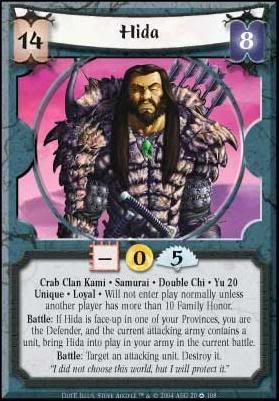
“HIDA!”
The Lord of the Crab had joined the battle.
Hiruma watched as his lord single-handedly destroyed more of the foul beasts than any twenty men. Hida, fighting side by side with his son Atarasi, towered above his soldiers, as large as the ogres that assaulted them. Even as he watched, the Kami shattered the skull of an oni with his tetsubo, then grabbed an ogre in a bear hug and crushed the life from it. Hida’s mood seemed to fluctuate between outrage over the attack on his people, and rapture at the chance for such grand combat.
Despite Hida’s power, it soon became clear that his men would be overrun even if he were not. The Crab Kami shouted for his men to rally about him, destroying all foes that came within their reach.
Hiruma was the first to reach his side, and Kaiu and Kuni met him there an instant later. Focused, fighting as one, the tide turned, and the warriors of the Crab Clan soon stood in a field littered with vanquished foes.
“What will become of the Crab indeed?” Kaiu asked, grinning at Hiruma.
Hiruma lifted his sword, and saluted his brother-in arms.
“Why are you telling me these stories?” Kaimetsu-Uo demanded. “I wish to hear about the Day of Thunder. What purpose do these other tales serve?”
“Your grandfather knew, as my kind knows, that mortals are prideful beings. You must remember the past, lest you fail to learn its lessons.” Unmei’s words were accompanied by the shimmering image of a golden bird, immolated in fire. “The human Isawa was powerful, but arrogant. Of course some would say his arrogance was not entirely misplaced, for he truly was unique in his time. Yet his pride nearly destroyed him, as it destroys virtually all who succumb to it.”
 Fires of the Phoenix
“Lord Isawa.”
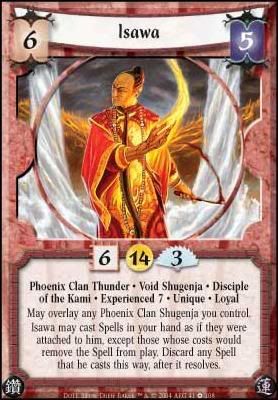
The voice drew Isawa’s attention away from the scroll he had been laboring over for the past few hours. He glanced up irritably, placing his pen in the tiny cup of ink and massaging his hand gently to alleviate the cramping. He had not noticed the discomfort until he had been interrupted, which was only an additional reason to be angry. He had left specific instructions not to be disturbed. “What is it?” he demanded harshly. “I have far too much to do to tolerate interruption.”
“Forgive me,” the servant said meekly, staring directly at the ground in front of Isawa’s feet. “We have received word from the southern villages that lord Shiba approaches.”
“Lord Shiba?” Isawa asked, his voice low. “At what point did members of my tribe begin referring to Shiba as ‘lord’?”
“Ah, f… forgive me, Isawa-sama,” the servant stammered. “I did not mean to… it was not my intent to show disrespect.”
“Disrespect is exactly what comes of paying homage to the Kami,” Isawa said, rising from his desk. “I became the ruler of this tribe because of my power, my wisdom, and because I alone led these people to prosperity. I earned these things.” He shoved past the servant, out the doorway and into the village’s streets, swinging his arms wide to encompass all that was around him. “What has Shiba done?” he demanded. “How has he earned your loyalty? He and his siblings expect obedience and loyalty due solely to the circumstances of their birth! And we have no means to say whether or not they are who they claim to be!”
The servant seemed suitably cowed, but others nearby were doing their best to ignore Isawa’s outburst. He lowered his hands and grimaced. His temper had grown short of late, as his frustration increased. So long as Shiba and the other Kami continued their efforts to organize their Empire, Isawa was forced to remain here in this meager village rather than in his far more suitable study at Gisei Toshi. Isawa was unwilling to allow others to speak for him, but he was equally unwilling to allow Shiba and his followers access to Gisei Toshi. Until these matters were resolved, Isawa would remain here, closer to the events unfolding beyond his people’s lands.
The shugenja sighed in disgust. “When Shiba arrives, show him to an empty house. I will meet with him at my convenience.” He folded his hands into the sleeves of his robes. “Until he arrives, however, I do not wish to be disturbed. For any reason.”
It was only a few hours later that Shiba arrived at the city. Say what one might about the Kami, Shiba was at least extremely punctual. Realistically, Isawa was sure the man had other positive qualities, but he was so maddeningly serene that it was difficult to imagine what they might be. From time to time, the shugenja wondered if on some level he envied Shiba’s harmonious mindset. It was, in theory, the perfect state from which to commune with the spirits. But no, that was for those seeking knowledge, not for those who already possessed it. Serenity was a tool, nothing more, and one that Isawa did not need. Isawa would see Shiba when the Kami had waited an appropriate length of time. After all, it would not do to have the Kami believe himself more important than a mortal visitor.
“Greetings, Isawa-san,” the Kami offered as Isawa entered the building. As always, Shiba was sitting in a relaxed position before a simple shrine he had erected during his first visit, a shrine dedicated to the Isawa tribe’s own Seven Fortunes. Its presence annoyed Isawa, but he did not have the heart to remove a shrine dedicated to gods who had earned his respect. “Thank you for seeing me so quickly. I am well aware of your vast responsibilities in maintaining your… people.”
“The Tribe of Isawa,” the shugenja corrected. “Or the Children of the Earth. You may refer to us as the Phoenix Clan to outsiders if you feel you must, but do not disguise what we are when speaking to me. My allegiance to your Emperor exists only in so much as I refuse to leave the lands he has ‘given’ to you, but feel no ill will toward his Empire. I understand you have held his wrath against us and I appreciate your willingness to do so, even if we do not require your protection.”
Shiba did not respond with anger, or even mild irritation, but only inclined his head respectfully. “As you wish.” He leaned forward and placed another candle on the shrine before him. “You know why I have come?”
Isawa shook his head. “I had hoped for your sake you had come concerning another matter. If you wish to present your case again, then I fear you have wasted your time. My answer will be the same.”
The Kami sighed heavily. “The attacks on southern Rokugan have intensified, Isawa. Hida and his men have been driven from their homes by a horde of creatures too terrible to describe.”
“Unfortunate,” Isawa said, “but ultimately of no concern to me.”
“There have been other incidents,” Shiba persisted. “Lady Shinjo’s followers have reported attacks by the same types of creatures, as has our neighbor to the west, Togashi.” He turned to look Isawa in the eye. “I believe it is only a matter of time before they appear here. It may be days, possibly less. We have been fortunate because of a quirk of geography, nothing more. We must join the fight, for the sake of our people.”
“No.” Isawa’s tone brooked no disagreement. “For the sake of my people, I must remain here. If these forces are foolish enough to attack us here, then they will be destroyed. Your brother will soon understand the enemy he would make in me.”
“And you feel no obligation to the others in Rokugan?” Shiba asked, incredulity in his voice. “Thousands of innocent lives have already been lost. Thousands upon thousands might yet die. I have sent as many of my men as I can spare to join the war effort. Asako has sent many of her people to tend the wounded. Will you do nothing?”
“Not nothing,” Isawa insisted. “I am defending my home. I see nothing more important.”
It was Shiba’s turn to shake his head. “I do not understand how you can so distance yourself from others. We all share this world, Isawa. You call yourself Children of the Earth, yet you do nothing to defend it?”
“I defend that which is mine,” Isawa returned. “No man can protect everyone.”
For the first time, Shiba’s face showed signs of irritation, secretly delighting Isawa. Before the Kami could respond, however, there was a shout from outside in the street. “Father!”
Isawa leapt into motion, crossing the room and exiting the building in a flash. “Akiko! What is wrong?”
His daughter, a vision of beauty by any standard, had little color in her face. She gestured mutely to the east, where a column of smoke was beginning to rise. “Toshi Tetsuharu,” she breathed. “Something must be terribly wrong there.”
Isawa turned to the Kami. “Is this your doing?” he demanded, fury in his eyes. “Did you orchestrate this to convince me of your argument?”
“If you believe I would harm any of our people, then you are a fool,” Shiba said plainly. “This is what I have feared would happen. We must go there, and save what lives we can.”
“You will leave immediately!” Isawa commanded. “I have had my fill of you and your divine family!”
“Father,” Akiko interrupted. “Shiba can help us.”
Isawa turned on her in his wrath, but his anger faded quickly. He was silent for a moment. “I will accept his aid,” he said finally, “but only if you remain here.”
“Father!” she exclaimed.
“I will hear no objections,” he said firmly, and she quieted at his tone. “Sagoten!”
“Here, my lord.” His daughter’s betrothed appeared instantly. “What do you wish of me?”
“Gather my finest students,” Isawa commanded. “We leave immediately.”
Toshi Tetsuharu, Iron Crane City, was so named for the unusual color of the waterfowl that constantly hunted for fish in the shallows along the coast. The term “city” was a misnomer, as it was hardly larger than any other of the Isawa tribe’s many southern villages. The people there prided themselves on the amount of fish they caught, much of which went to other villages. There were few who challenged their claim to be called a city.
Today, Toshi Tetsuharu burned.
Creatures rose from the sea, their bodies made up of dark, cloudy water that seemed to be taken from the ocean’s floor. Their watery forms shrugged off physical attacks, and smoldered as if from a strange heat. Everywhere the creatures touched, their targets would dry out, then smolder and burst into flames. Even as Isawa, Shiba, Sagoten and the others arrived, the scent of burning flesh was heavy in the air.
“Foul creatures,” Isawa snarled as the beasts turned their attention to the newcomers. “Let me show you the true power of fire.” With a wave of his hand, he summoned a torrent of flame that scoured an entire street, enveloping three of the creatures. They screamed, a roaring sound like that of a seashell held to one’s ear, and then were gone.
Sagoten and Isawa’s other students moved through the city in a careful group, using precise, directed magic to destroy the beasts one at a time. For all their power, the creatures possessed little subtlety or sense of stealth; their attacks were direct and unsophisticated. Sagoten was the most powerful of Isawa’s students, but his water magic was least effective against the beasts. Unable to seize control of their physical forms, he instead forced more water into their forms, shattering them from within into small pools of steam.
Shiba moved through the city like a phantom, moving with a speed that would have given his twin brother Bayushi pause. Though no other physical attacks seemed effective against the creatures, Shiba’s lightning-fast strikes sliced them into more pieces than they could easily control, rendering them unable to reform their bodies.
Isawa hovered above the city, with little need for the precision displayed by Sagoten or Shiba. He unleashed massive waves of energy that divided into multiple tendrils, each unerringly seeking out one of the creatures somewhere in the city. Within a matter of moments after their arrival, the combined forces of the Phoenix had decimated their foes, but at a heavy cost.
The entire village of Toshi Tetsuharu was in ruins. The fires that the creatures had caused spread quickly despite the shugenja’s attempt to stop them. It was not until Isawa had destroyed the last of them and summoned a great rainstorm that the fires were quenched, but by then it was far too late.

Shiba stood in the rain, his armor glistening as the raindrops reflected the last rays of the afternoon sunlight. He closed his eyes, offering a prayer for the many who had perished. When he finally opened them again, he regarded Isawa with a terrible sorrow. “Do you understand?”
“I understand that no one else can hope to stop this threat,” Isawa said after a moment’s consideration. “The Tribe of Isawa will offer what aid it can, Shiba, but its lands will not go undefended. I will send my finest students to aid your men, Shiba. Sagoten has my trust. He will command them. But I will remain in Gisei Toshi.”
“I cannot allow that,” Shiba countered. “Sagoten’s father Yogo already aids in the war effort. I will not risk both Asako’s husband and her son.”
“Then I will find another,” Isawa said firmly. “The troops will be ready at first light. Take them or leave them.”
“Thank you, but I fear the day is soon coming when you can no longer remain neutral in this war, Isawa.” Shiba’s eyes pleaded with the shugenja. “I fear that you will regret not acting sooner. Together we can stop this threat before it arrives on your lands.”
“If you would fail without me,” Isawa replied, “why do you deserve me as an ally?”
The shugenja turned and left Shiba standing in the street, rain falling gently around him.
“Fu Leng’s armies slowly marched north, destroying all that lay in their path, and even the mighty Crab were hard pressed to stop them,” Unmei said. “Now we come to the part of the tale that you likely already know.”
“The tale of the Seven Thunders,” Kaimetsu-Uo replied. “I would hear you tell it nonetheless.”
“Of course,” Unmei replied. “After all, the same tale told twice is seldom the same, and I think perhaps you have not heard this version.”
“Oh?” Kaimetsu-Uo replied.
“Seven Thunders and a prophet rode south to battle the dark god, but for a time another rode with them,” Unmei said. “Another whose identity was buried by history for his own sake. Yet he told his tale to Hida, and Hida told it to me…”
A Gathering of Thunder
My father always taught me that some things are simply meant to be. Some events are destined to occur, and will happen regardless of what we do to prevent them. In truth, this is very rare. Father taught me that the more important something is, the less inevitable it is. After all, if something is important but would have happened on its own no matter what we did, well, then it was never very important at all. Choice is what defines us. Choice is what makes us who and what we are. Most of the time, the kharmic wheel can spin one way or the other. Destiny offers us a choice even when — especially when — we would prefer not to have one.
I was only a child then, but I still remember it all clearly. How could anyone forget a time such as that? I stood in the shadows of the throne room and watched my father speak. It was amazing to see the most powerful men and women in the Empire hang upon his every word. I had always admired my father more than any other man; he was without a doubt the wisest, bravest, and gentlest man I have ever known. But these were gods, and they looked upon him as if he were their savior.
At least most of them saw him that way. Akodo never seemed to trust Father, and Togashi rarely spoke to him, always remaining in the back of the room and just listening. Sometimes I felt the Dragon Champion’s eyes upon me and looked up. I always quickly looked away; to look into those eyes was to look into depthless eternity. All of the Kami were different from one another, but Togashi was the one that frightened me most — except for Fu Leng, of course.
That was why the Kami had gathered here today. My father had summoned them, and they had come at his command, stepping away from the war in the south, abandoning their duties to their clans, all to hear my father speak. I felt a sense of overwhelming pride, and was confused not to see that pride reflected in Father’s eyes. He regarded the Emperor and the divine leaders of the Empire with the same friendly smile and calm serenity with which he’d greeted the baker’s wife earlier that morning. There was no arrogance in him, only patience, wisdom, and the eternal hint of mischief in the corner of his smile.
“The time has come,” my father said, pushing his wide straw hat back over his shoulders. “The end of the war against Fu Leng is nigh.”

Hantei leaned forward in his throne. The Emperor’s face was shiny with sweat. He had been grievously wounded in a recent battle and was said to be very ill, though of course he denied the rumors. His son Genji stood at his right hand, casting a look of concern at his father. “My scouts report that Fu Leng’s army is on the march,” the Emperor said, his voice a low croak. “They prepare to assault Otosan Uchi once more. The hordes are three times the size of our armies. Are you telling me we are doomed, Little Teacher, or that you have found a way to defeat Fu Leng at last?”
“The end is not yet written,” my father answered. “It is for us to decide. This is more than a simple war, Your Majesty. Certainly when you and your brethren fell to earth, you sensed that you were drawn here for a purpose… at least one of you was.”
“Speak clearly, little man,” Akodo demanded with a glare.
“The mortal realm stands between your home in the Celestial Heavens and Jigoku, the Realm of Evil,” my father replied. “Jigoku eternally seeks to spread its corruption through this realm, while the powers of the Celestial Heavens seek to leave this realm free to seek its own fate. In every age, there is a confrontation between the Champions of both realms. Jigoku has chosen its champion already. He must be defeated before this will end.”
“Our brother,” Shinjo said in a quiet voice. “Fu Leng.” She hissed when she said the name, as if uncomfortable with its sound.
“It is as I always thought,” Hida said with a smirk. “Strike off the head and the body dies. I told you your sword was too slow, Akodo. You should not have hesitated to kill him when you had the chance.”
“You dare?” Akodo said, turning to face Hida. The Lord of Lions glared at his brother, head turned slightly to the left as he focused his remaining eye on Hida. “A child of heaven does not murder his brothers, no matter their crime, Hida,” he snapped. “Be grateful of that the next time you question my courage.”
Hida smiled broadly and opened his mouth as if to speak some retort. The smile faded as he thought better of it and he looked away from Akodo.
“Tell me this is not the answer, Little Teacher,” the Lady Doji said softly. “Is there not some way that our lost brother can be saved? Must we destroy him?” Lady Doji never spoke Fu Leng’s name. I had heard that the Kami once called their brother by another name, but that name is buried with the memories of the brother he had once been.
“Wherever his fate lies, it is outside of your hands, Doji-sama,” my father told her, his voice filled with sympathy. “As I said before, the Celestial Heavens leaves the mortal realm free to seek its own fate. Those who face Fu Leng must be chosen from among the mortals.”
“Preposterous,” Togashi said in his strange, hollow voice. “What you ask is impossible.”
“You spend too much time apart from the mortals, brother,” Bayushi said, stroking his chin beneath his ragged cloth mask. “I have seen many of them perform the impossible. Perhaps what the Little Teacher says is correct. Where armies have failed, perhaps a small group of chosen warriors could find our brother’s camp and destroy him.”
“They would die,” Togashi replied. The Lord of Dragons always seemed to question my father’s advice more than any of the others.
“How is that any different from the war we fight now?” Shiba countered, standing beside his twin brother. “Bayushi’s followers run through the shadows, counting legions of demons, sabotaging the Dark Lord’s supply trains. The Scorpion die every day so that we might breathe another hour. What if the sacrifice of a few heroes could end this war forever, Togashi? Would you not take that risk?”
“Perhaps,” Togashi answered thoughtfully.
“My son knows the Shadowlands like no other,” the mighty Hida offered. “He could guide a band of Bayushi’s killers through Fu Leng’s front lines…”
“No,” Bayushi said, his voice tense. “I have no more children for Fu Leng to kill. Too many have died already. None remain who could do this deed, none that I can spare. Let a Lion do this deed, or a Ki-Rin.”
“Let us all share in this responsibility,” Hantei said, his voice quavering only slightly as he sat higher in his throne. “If we succeed, we shall all share in the glory. If we fail, we will know each of us did all that he or she could. We shall send one hero from every clan. Seven heroes to follow the Teacher to his destiny. Seven Thunders to summon a storm that will wash my brother’s foul touch from the Empire.”
At those words, I saw my father smile, as if he had known he would hear them.
“Fu Leng is a god,” Shinjo said. “I am still not convinced we should not face him ourselves.”
“It is not your destiny,” Shinsei said. “Any but the Thunders who stand before Fu Leng will be ground beneath the wheels of destiny.”
“Then Seven Thunders it shall be,” Hantei said. “Who shall be first?”
“Not me,” Bayushi snapped. “Not ever. I forbid any more of my vassals to die in this war. Punish me how you will, brother, but no more Scorpion blood shall flow in the Shadowlands.” Bayushi turned and stormed from the chamber. Several moments of tense silence followed.
Akodo nodded to a tall warrior by his side. The man stepped forward, smoothing one hand over his luxuriant black beard as he stood boldly before the Kami. “I am Ikoma Jujinin, eldest of Ikoma’s nine sons.” Ikoma had never taken a wife, but from the tales I had heard I was not surprised to hear of his many sons. “My father has proven himself as the Right Hand of the Lord of Lions,” Jujinin continued. “I shall honor his example by…”
Jujinin’s speech was interrupted with a sharp crack as a tall woman in brilliant golden armor struck him across the face. He fell to the ground, dazed eyes staring blankly at the ceiling.
“I am Matsu,” she said simply. “I am ready.”
My father grinned and bowed deeply to Lady Matsu.
Then Togashi gestured to one of the men that stood beside him. The man stepped forward, a tall samurai in deep green armor. His head was shaven in the manner of a monk, but his calloused hands and steel eyes were those of a warrior.
“In the name of the Dragon Clan, I would fight beside you, Matsu,” he said in a gravelly voice. “I am Mirumoto.”
I recognized the name: Togashi’s own bodyguard. Strange that Togashi would question my father one moment then offer to sacrifice his own yojimbo the next — but then I hear the Dragon are a strange people.
“My son Atarasi is on the front lines, Little Teacher,” Hida said. “Seek him there.”
“And I shall send for my finest warrior, Otaku,” Shinjo added.
“Come with me to attend my husband, Kakita, here in the city,” Lady Doji offered next. “He will choose the finest Crane samurai to join these heroes.”
Shiba looked thoughtful, as if uncertain who to offer, or if they would accept the honor. My father bowed deeply, as if satisfied with the choices they had made. He turned to leave and Mirumoto bowed to his lord Togashi a final time, offering his silent thanks to be chosen for such a duty.
I noticed Matsu did not turn and bid farewell to proud Akodo, nor did she ask his leave. Her eyes were set firmly upon the door, ignoring everyone but my father. Bold Akodo had turned his attention to the nearest window, his good eye turned toward the wall. Shinjo looked upon her brother in silent sympathy. Both had faced Fu Leng in battle; they knew better than the rest what lay ahead for the Thunders. Akodo would not bar Matsu from her destiny, but even bold Akodo could not summon the courage to watch her depart to meet such a fate.
I followed my father out of the throne room.
“What is wrong, little crow?” Father asked me as we walked. “You look sad.” Doji, Matsu, and Mirumoto had moved far ahead, already discussing the challenge that awaited them.
“It is nothing, father,” I said, my eyes upon the floor.
“Oh,” he replied, and we continued walking silently. He waited patiently for the answer, as he always did.
“I always thought of the Kami as gods,” I said, looking up at him. “They are greater than us all. But Akodo’s rage, Bayushi’s grief, Togashi’s doubt… I did not expect them to be so… so flawed.”
“Then think on this,” Father answered. “How would you feel if Akodo felt no remorse for wounding his brother? If Togashi accepted all things without thought? If Bayushi cared nothing for the lives of his people?”
I thought about this for a moment. “I would be afraid,” I said.
“What seem to be flaws are often strengths, little crow,” father said with a grin. “Think upon that as we gather our heroes.”
In all my travels at my father’s side I have seen great and terrible things. Many things have impressed themselves on my memory, but there is one I shall never forget. It was the moment that Fu Leng truly came closest to destroying the Empire.
We had not expected the battle to begin so soon.
In the corner of the chamber, Lady Doji embraced a young Crane girl who sobbed quietly as she clutched an infant to her breast. In the center of the room stood the Emperor’s Champion, Kakita. His blade was drawn, dripping foul ichor on the marble floor. Mirumoto stood at his back, a sword in each hand as his eyes scanned the chamber. In the distance, Matsu’s cries echoed through the palace, rallying the Imperial Guard. On the floor beside them lay the twisted body of an oni, beheaded by Kakita’s sword. It had fallen by the body of Doji Yasurugi, son of Doji and Kakita, the hero who had stepped forward to be the Crane Thunder. The oni’s laughter echoed through the chamber long after its death, mingling with the startled cries of Crane courtiers.
My father knelt on the floor, oblivious to the blood and ichor that pooled around him. He laid one hand upon Yasurugi’s heart, and looked bleakly into the dead Crane’s eyes. It was something I had never seen before and never since, and in that moment the Empire had come closest to its end, even though none ever knew. What frightened me most was not that the Crane Thunder had died, or even that Fu Leng’s oni had infiltrated the Imperial Palace itself.
What frightened me most was that my father had lost hope.
“Accursed beast,” Mirumoto snapped, seething with fury. “Fu Leng knows our plan even before we begin!”
“We are lost,” my father said, head bowed in defeat.
“No,” said a soft voice.
A girl stepped from the crowd, small and slight; I had not noticed her before. She knelt and picked up the sheathed sword that lay on the floor beside the wooden cradle, the sword Yasurugi had dedicated to his newborn son only moments before his death. Still kneeling, she drew the sword, which sang with a resounding crystal note, banishing the oni’s echoing laughter from the room. “My brother’s soul is here.”
My father stumbled slightly as he stood and moved quickly to her side. He reached for her chin with a shaking hand. She looked up at him, eyes blue, clear, and determined. “A twin,” he said, voice barely a whisper. “Yasurugi’s twin.”
Behind him Matsu burst into the chamber again, sword in hand, scanning the room for any sign of further attack. Lion troops flooded into the chamber behind her to reinforce the room, much to Kakita’s annoyance.
The Crane girl nodded. “Hai,” she said.
My father laughed out loud, pulling her to her feet and clasping her in a sudden embrace. “We are not yet defeated, my friends! The Soul of Thunder lives on in her!”
“Konishiko?” Lady Doji exclaimed, shocked. “You would ask that I send little Konishiko against my brother?”
“If such is her kharma, my love, then I have faith that she will bear her brother’s destiny with honor,” Kakita said. He sheathed his sword and bowed to his daughter, then turned to the Dragon. “Protect my daughter, Mirumoto.”
“Protect my Empire, Kakita,” he replied.
“Let him do a better job than his guards did protecting the palace,” Matsu said, sneering at the dead oni.
“Watch your tongue, Matsu,” Kakita hissed. “We are allies. My daughter may well save your life in the Shadowlands.”
Matsu laughed out loud and scowled down at the Crane girl. “She is no warrior,” the Lion said in a loud voice. Konishiko stepped away from my father, looking up at Matsu defiantly. Matsu slapped at Konishiko’s sword with her own blade, lazily attempting to knock it from her hands. A sharp clang of steel on steel resounded as Konishiko disarmed the Lion more swiftly than anyone could see. Matsu held her sore wrist in one hand then nodded to the Crane girl in respect. Konishiko returned the gesture, moving away to kneel once again beside her fallen brother.
“I think we will do fine,” Mirumoto said to me with a lopsided smile.

The mountains of the Phoenix were cold and forbidding, but very beautiful. In that regard they were much like the people who dwelled in them. The Tribe of Isawa, the Children of the Earth, were a sophisticated people. They possessed knowledge far beyond that of the rest of the Empire. Yet that knowledge also kept them apart. In more primitive times, before the Kami fell, the other tribes were greatly jealous of the Isawa. Some would stop at nothing to destroy them, either to pillage their great knowledge or to simply eliminate those who possessed powers they did not understand. Was it any wonder they wished to remain apart even after the Kami came?
Shiba changed all of that. He brought the Children of the Earth into the Empire using a most unexpected method — humility. The Isawa would be treated as equals, given protection, support, and the freedom to continue their research. That freedom, of course, had a price. I remember the last time I visited the Phoenix mountains with my father, and met the man who paid that price.
It was often said that Isawa was the most powerful man in Rokugan, but he did not seem so that day. He was a very small man who often dressed in robes far too large for his skinny frame. A wide hat concealed his features. Many small amulets and magical fetishes hung from his clothing. He clutched one in both hands as he knelt beside a small shrine to his sister, chanting intently in the language of his tribe.

I stood beside my father, who gestured for me not to interrupt. Even the noisy crow that often perched upon my father’s shoulder, the creature he nicknamed me for, fell silent at the sight of Isawa. The little bird was still white then, its feathers still untouched by Fu Leng’s shadow.
After a while, Isawa ceased his chant abruptly. He turned, peering over his shoulder. “Yogo has been forever cursed,” he said. “Ariminhime is dead. Gisei Toshi will never be as wondrous as it once was. Each time we enter combat with Fu Leng’s minions we pay a heavy cost, Little Teacher.”
“Do you believe by remaining neutral you will be safe?” my father asked.
Isawa frowned. “I did, once,” Isawa said, “but it seems the Kami’s enemies bear a hatred for all life, even we who have done nothing to rouse their anger.” Isawa fell silent for a time. “Yet now Fu Leng has finally made an error. He has roused my anger.” He lifted a heavy satchel of scrolls from beside Ariminhime’s shrine and looked at my father with a flat, imperious expression. “I would have had my vengeance one way or another, Little Teacher. Now that we are allies, your Thunders are welcome to share in my victory.”
Isawa bowed to my father and then made his way past us, back down the path to Gisei Toshi where the other Thunders waited. I looked up at my father, who watched Isawa with an unreadable expression.
“You always taught me humility was a sign of enlightenment,” I said to my father. I tried not to speak ill of the important men my father met with, but Isawa bothered me with his arrogance.
My father smiled then. “That is true,” he said. “Perhaps Isawa is humble, and his power is even greater than he would have us believe.”
“Is that possible, Father?”
My father looked off to the southwest then, where black clouds gathered. “Let us hope so, little crow.”
In our travels throughout the Empire, Father and I usually walked; steeds were for wealthy people and we were not wealthy. The Emperor was, and he insisted we make haste, so we had the finest horses. Father adjusted to the saddle with the same quiet mastery he applied to everything he did. I confess I took a great deal of time to grow accustomed to it.
On the road south toward the Shadowlands, we met a single rider. The horse galloped toward us at extraordinary speed, and for a moment I thought it might continue without stopping. At the last moment, the rider gently tugged the reins and the horse wheeled to a halt with extraordinary precision. Using the momentum of the charge, the mounted samurai leapt from her saddle and landed in the road before my father. She knelt, head bowed, pressing one fist upon the earth. A brilliant purple sashimono flapped from her armor, bearing no mon.
“A Ki-Rin,” my father said, bowing from the saddle. “Lady Shinjo told me to expect you. You are Otaku.”
The woman stood. Her expression was stern and confident. Hers was not Matsu’s fiery, temperamental pride, but rather a quiet, sincere assurance in her own abilities. She looked to my father, then to each of the other men and women who followed us. Her eyes widened slightly when she saw little Konishiko, but after looking into the Crane’s eyes her doubt quickly faded. She finally looked at me, then back at Father again, nodding.
“We ride for the Crab lands,” my father said. “Can you keep up?”
Otaku’s expression was shocked. She opened her mouth in outrage, then stopped. She laughed then, a bright and vibrant laugh. It was the only sound I ever heard her make.
Then she bowed again, as deeply as she could, climbed back into her saddle, and continued the journey beside us.
The lands of the Crab had been utterly ravaged. I had never seen such a thing. Entire forests had been set ablaze by elemental oni, villages left in ruins by ravenous bakemono. Yet always, no matter where we traveled, I saw courage in the eyes of peasant and samurai alike. These sons and daughters of Hida were unlike any other people I have known, possessed of an indomitable will and raucous humor even when beset by enemies on all sides. It occurred to me that the Empire would have done well had Hida won the tournament to determine the Emperor, but with such an enemy as Fu Leng at the doorstep Hantei could not have selected a better defender.
While my father spoke to Hida and gathered what maps he could of the lands ahead, I was guided through the Hida camps by Atarasi, Hida’s son. He was a large man, like his father. Unlike Hida, he did not possess his father’s rowdy demeanor. Atarasi was quiet and thoughtful. There was a strange pain in his eyes as he looked upon the blasted lands that were his home, describing details of the outpost in terse phrases. I could not help but try to comfort him.
“Why so grim, Atarasi-sama?” I asked. “The Crab suffer now, but once we have vanquished Fu Leng your people will be safe again.”
“They are not my people,” Atarasi replied. “They are my father’s people.”
“But you are Hida’s heir,” I replied.
Atarasi shook his head. “I have known since this war began that I am meant to die,” he answered. “That is why I keep my distance from the others. At least now, knowing I am a Thunder, I know my death will have purpose. Even so, I know I shall die alone.”
Atarasi looked at me with a sad, distant expression. I could think of nothing to say. Nothing Father had taught me, no wisdom I had gathered from the Empire’s finest scholars could help me bring the grim Thunder cheer.
“No man ever dies alone with loyal comrades by his side,” came a voice.
I looked up at the sound, as did Atarasi. A thin woman in crimson and black approached us. A thin veil covered her face, scarcely hiding the lovely features beneath. She wore light armor, only enough to cover her shoulders and midsection, and carried a long, wicked spear in one hand. She had all the deadly beauty of a spider’s web.
“A Scorpion,” Atarasi said, a note of admiration in his voice. The Scorpion had been the Crab’s strongest allies in this war, their scouts daring to explore the deadliest regions of the Shadowlands alongside the Crab’s stout warriors. “Have you come to report?”
“I have come to meet you, Atarasi-san,” she said with a light chuckle. “I am Shosuro, the Scorpion Thunder.”
“Oh?” Atarasi replied, surprised. “The prophet said Bayushi forbade his followers to join this quest.”
“Bayushi forbade any more of his followers to die in this war,” Shosuro answered. “I do not intend to die, Atarasi-san.”
Atarasi laughed at that, showing the first trace of joy I had seen in the dour Hida’s eyes.
It was then that I realized that my father had appeared beside me, though as usual I had not heard him approach. He placed one hand upon my shoulder as he looked upon Shosuro with a satisfied expression.
“Seven Thunders at last, little crow,” he said.
“You knew Shosuro would come, didn’t you?” I asked.
“I did not,” he replied. “The choice was always hers. Destiny offers us a choice, when it matters. I merely hoped that she would choose wisely.”
My father’s words remained with me long after he gathered the Thunders and journeyed into the Ninth Kami’s lands. It was a strange revelation to me, as that was the day I finally understood my father.
People often believed my father was infallible, so wise that he never made a poor decision, and always certain what the future held. That was not so. My father was just a man, a wise man who always placed his faith in noble and honorable souls. If it seemed he never made the wrong decision, it was only because of his confidence in the goodness of others. His example inspired those around him to do what was right.
Seven men and the Little Teacher entered the Shadowlands, prepared to do battle with the champion of all that was evil. As the Crab soldiers watched them march past, there was fear and doubt on many of their faces. For me, there was no doubt, there was no fear. I did not believe for an instant that the Thunders would fail. Father taught me too well for that.
“Strange,” Kaimetsu-Uo said. “I think that I have finally learned that which I came to hear, though I did not hear the tale I sought.”
“I would not have you disappointed, my friend,” Unmei said. “Now listen to a tale of your Empire’s greatest heroes.”
Day of Thunder
Hida Atarasi stood at the edge of a jagged cliff and looked out into the Shadowlands. The earth was cracked and blasted, clean of all vegetation save a handful of twisted, thorny weeds. A thin river of oily black water meandered through the wasteland, bubbling with unhealthy gases and the quick, furtive movements of creatures better left unseen. The sky swirled with inky black clouds, casting the land in an eerie half-light that was neither day nor night.
“These lands were beautiful, once,” he said in a low voice. “I remember scouting this area with Hiruma. This was a forest. We caught a fish from that river, the finest I have ever tasted in my life… This place is dead now. Fu Leng has murdered it, Shosuro.”
“You heard me approach?” the Scorpion said, clearly impressed as she stepped out of the shadows. “Not many men can do that.”
Atarasi smiled at her. “One does not survive long in a war such as this without learning how to read the shadows,” he said.
“How long have you known I was there?” Shosuro asked.
“Two hours.”
“You said nothing?”
“You seemed at peace. I felt it would be rude to interrupt,” he said.
Shosuro studied his face. There was no mockery in Atarasi’s words, just his usual grim sincerity. “Then why did you speak to me just now?” she asked.
“Because of all of us you seemed the most likely to understand what we have lost,” Atarasi said, looking out at the Shadowlands again. “Both of our clans have suffered in this war. Even if we win here, these lands will never be the same. Win or lose, this is the Crab’s future.”
“You shouldn’t dwell on such things, Atarasi,” Shosuro said. “Doubt can kill a man more swiftly than a sword.”
“I know that,” he said with a bitter smile. “I have seen it happen often enough. I try to be like my father. Hida is never afraid. He never makes mistakes. I try to be like him but how can I? I think sometimes my human blood is too strong.” Atarasi clasped his hands together before him, eyes focused on his trembling fingers.
“I have no words to reassure you, Atarasi,” Shosuro said. “I don’t think words would help.”
“Then I hope the battle comes soon, Shosuro,” Atarasi said. “In battle there is no doubt. It is the times in between that may kill me.”
Shosuro nodded, looking around them carefully. “Especially in such a place as this. I cannot help the feeling that we are watched, that we are being followed. I will be glad when this is done.”
“My father taught me that strength is the only commodity that increases when shared,” Atarasi said. “Shinsei believes we are the greatest warriors in the Empire. Perhaps he is right, then perhaps we will be victorious.”
“I am not used to sharing strength,” Shosuro replied. “I have always fought alone.”
“In the end, we are all alone,” Atarasi answered, “but until then perhaps we can still make some difference.”
A lone god stood at the edge of the Shadowlands and wondered if he was about to make a terrible mistake.
All his life, Shiba had served. He had honored his father and mother even when his father devoured him and his mother abandoned him. He had obeyed his brother’s commands and helped him establish his empire. He had even cast aside his pride to kneel before Isawa so his tribe might see the wisdom of standing united.
Shiba had always understood that humility was the truest form of courage. To cast aside one’s own desires for the good of all was difficult, but he had always brought himself to do it. Even Shiba had his limits. He would gladly give up his life, his honor, all that he had for this Empire he and the others had founded…
But he could not let the Thunders die.
The others were assured that Shinsei’s claims were true, that only the Thunders could defeat Fu Leng, but Shiba was not so sure. Shinsei was a wise man, but he was not infallible. What if he was wrong? What if they could not defeat Fu Leng?
Shiba stared at the gleaming blade of Ofushikai, the incredible sword his wife had made for him. They were not his people, these mortals, but he had come to love them. He knew each of his brothers and sisters had as well, each in their own way.
“Any but the Thunders who stand before Fu Leng will be ground beneath the wheels of destiny,” Shinsei had said.
So be it, then. Shiba sheathed his blade and entered the Shadowlands.
“You should extinguish that fire, Phoenix,” Matsu said, marching back into the camp with her usual surly frown.
Isawa huddled against a large stone, not looking up from his scroll as the Lion approached.
“Why?” he replied.
“Are you a fool?” Matsu said with a sneer. “Fu Leng’s servants will see the smoke.”
“I have spoken to the smoke,” Isawa said with a sigh. “We will not be seen. Leave me alone.”
Matsu stared at him for while, uncertain whether to believe him. “Arrogant Phoenix,” she whispered.
Isawa looked up at her placidly. “Do you need something from me?”
Matsu sighed, turned, and stormed off across the camp.
“She is very angry.”
Isawa looked up, startled at the sound of the unfamiliar voice. He realized to his surprise that Otaku was sitting on the other side of the small fire. He had never heard the young Ki-Rin speak. “It is her way,” Isawa replied, looking to his scrolls again. “Matsu is a killer, ever vigilant for any sign of weakness in ally or enemy. Though she may be unpleasant company, we are fortunate to have her with us.”
“Are those spell scrolls?” Otaku asked.
Isawa nodded. “We use these in Gisei Toshi, to purify the bodies and souls of the dead and bind them to the walls so that they might defend the city forever,” he replied. “Shiba and his samurai have promised to protect my tribe now, so such measures will no longer be needed. I brought them because they remind me of my sister. Reading them brings me focus, and I need focus most of all right now. The battle we will soon face is impossible. By all accounts Fu Leng is immortal, and I must find a way to defeat that.”
“Why not use your scrolls against him?” Otaku asked. “If they can bind the souls of the dead, could they not bind Fu Leng’s soul as well?”
“It is not that simple, Otaku-chan,” Isawa said with a chuckle. “You see, the spiritual alignment inherent in the souls of the dead is different than that of living beings. They are more strongly connected to the realms beyond our own than this one, giving a skilled shugenja some ability to manipulate their place in this realm.”
“Is it not the same with Fu Leng?” she asked. “He was born in the Celestial Heavens and wields the power of Jigoku. Are those not realms outside our own?”
Isawa opened his mouth to offer a quick rebuttal, then stopped. Possibilities began quickly forming in his mind. It would be difficult, requiring an unusual application of the scrolls, but certainly possible. His jaw dropped open and he stared blankly at Otaku. After another moment’s consideration he shook his head in denial. “No, it would never work. He would be bound, but still alive.”
“Shinsei never said we must kill Fu Leng,” she answered. “Only defeat him.”
Isawa gave a tight smile and shook his head, but could offer no argument. A slow realization came over him. This girl, this Ki-Rin girl who had not spoken and whom he had thought very little of since her arrival, may very well have shown him how to defeat the Dark God.
“By the Fortunes, Otaku, you have saved us all,” Isawa breathed, digging through his scroll bag. “This will take time and preparation, but it may work. I must study these thoroughly to find the proper pattern.”
“Can I help?” she asked.
“My scrolls are complex, beyond the comprehension of…” Isawa stopped himself and looked at Otaku with a respectful smile. “Yes,” he said. “I think that perhaps you might help.”
“Again,” Mirumoto commanded.
Konishiko nodded and drew her brother’s sword, moving from one complex kata into the next.
“No. Too much weight on your leading foot. You have no balance. An enemy will exploit that,” he said sharply. “And your counterstrike is too slow — no form or control. Control the blade; do not chop with it. It is a katana, not a tetsubo.”
Konishiko gave Mirumoto a frustrated look and began again. “I defeated Matsu, Mirumoto-sama,” she said.
“You did not defeat Matsu, you disarmed her,” Mirumoto corrected her. “Matsu saw you as a child, not an enemy. Had she truly meant to kill you, you would have perished.”
“My brother’s soul guides me,” she said, holding the blade high again. “I will be fine.”
Mirumoto nodded, bowing deeply to Konishiko. Konishiko returned the gesture.
“Kill me if you can,” he said.
Konishiko’s eyes widened in surprise. Mirumoto lunged at her, not drawing his swords. She swung at him with her brother’s blade. Mirumoto slapped at the flat of the blade, twisting it in her hands, then kicked her in the stomach. She fell back on the earth. He landed with one knee on her chest and one foot on her sword arm, hand clutching her throat.
“Now are you so confident in your abilities?” Mirumoto asked. “Fu Leng will not see you as a child.”
Konishiko glared up at him, then closed her eyes in humiliation. Mirumoto rose and helped her to her feet.
“How is it possible?” she whispered, sheathing her katana. “My brother’s soul guides me.”
“Yasurugi may dwell within you, but so does Konishiko,” Mirumoto said, “and Konishiko is inexperienced. One day you may be a fine warrior, Doji-san, but that day has not yet come. You are reckless, inexperienced. I must teach you focus in the short time we have.”
Konishiko glared at him, her face burning with embarrassment. “Father tells me that your techniques are inferior. His technique is superior to yours.”
“I regret I do not have the opportunity to test the truth of that against him,” Mirumoto answered. “You respect your father, and that is admirable. But I am here and he is not.” Mirumoto drew his swords and fell into a kenjutsu stance. “If you wish to survive, you will learn from me.”
The young Crane watched the old Dragon in tense silence for a long moment, then brought her sword to the ready. “I will learn,” she said, “but my father’s way.”
Mirumoto nodded, sheathing his wakizashi and shifting to a one-handed stance.
“Let us begin.”
Shinsei entered the cavern alone, only a small lantern guiding his path. The crow sat upon his shoulder, peering about furtively as it huddled near its master’s neck. All within was silent, save the distant sound of dripping water. The Little Teacher moved forward slowly, cautiously, giving those that he knew waited within the chance to see him.
“I am here,” he said, though his words were in a strange, clipped language unlike that of humans. “I keep-keep my promise.”
A tall, inhuman creature stepped out from among the rocks. It resembled a large humanoid rat, though its fur was uneven and marred with countless scars. It was a Nezumi, one of the creatures that had ruled the Shadowlands before the fall of Fu Leng. “So you have,” the creature replied. “Scouts say that human farmers leave-leave rice in the fields for us.”
“I tell-tell them to do it for good luck, Chieftain A’tck,” Shinsei said, “to chase bakemono away.”
“Then you tell no lie, crow-man,” A’tck replied. “My hunters kill-kill bakemono wherever we find them. Your rice save many Nezumi from Tomorrow.”
“I am glad to help,” Shinsei said. “Now help-help me.”
“I honor our bargain,” A’tck said, “but I do not think this help you. More likely kill you.” The Nezumi reached into the pouch at its waist and drew out a tightly rolled piece of hide, handing it to Shinsei. “Heaven fall there. That is where our city stand, before Tomorrow swallow it away.”
Shinsei unrolled the map, trying not to think about what the Nezumi might have made it out of. The details were precise and carefully drawn, leading to a place named Heaven’s Grave. That was the center of Fu Leng’s power. That would be where they would find him.
“You go to fight the dark god?” A’tck asked, his black eyes wide.
Shinsei nodded. “I must.”
“A’tck understand the pull of ‘must,’” the Nezumi answered. “A’tck wish you well. Tomorrow comes for us all, crow-man. Best we can do is leave a strong Name, and hope we are remembered.” The Nezumi executed a stiff bow, mimicking the Rokugani custom. “You are a hero among Nezumi, crow-man. Many starving pups survive this winter because of you. Nezumi remember you, always.”
Shinsei smiled, touched by the Nezumi’s sincere gratitude. He returned A’tck’s bow, then turned and continued on his way, tucking the map into his robes.
In the darkness, far from the others, Lady Matsu knelt alone. She closed her eyes in meditation, preparing for the battle ahead. She thought of those at home — her beloved husband, her lord Akodo, her comrades in the Lion’s Pride. She had left them all behind without saying goodbye. Matsu had no taste for goodbyes. They only inspired fear that those she loved might be lost, desire to remain beside them, and regret for leaving them behind.
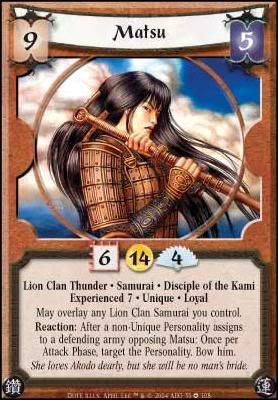
Fear, desire, regret. These things were sins, not the way of the samurai.
She knew she would never return to Rokugan.
The Lady of Lions hid her face in her hands. She had never feared death. She had welcomed it with open arms, the glory of battle, the reward of a true warrior. Win or lose, this would be a hero’s death, a death like none other. Yet she had not imagined it would be like this.
She had hoped to die among the Lion, among those who had become her friends and family since she had turned her back on her tribe. Her kin had been savage bandits once, wretches who had not understood the true purpose of battle. They killed for the sake of killing and nothing more. Once, she had felt the same. She indulged her naked bloodlust, slaughtering any who dared oppose her. She had even loved the son of one of the greatest raider chieftains and looked forward to a long life of pillage and murder by his side.
One day she realized how meaningless her life had become, and left her tribe. She lived many years alone in a small village, teaching all those who would learn how to use the sword and spear to defend themselves from those like her former comrades. When she met Lord Akodo she discounted him as another like the rest — a killer using the strength of his sword to justify his actions. In time he proved himself, and Matsu understood the true meaning of honor. She knew her destiny was to stand among the Lion.
She had hoped to die with them, and she had never looked back.
Matsu wiped her cheeks, ignoring the tears that fell. Such behavior was not becoming of a samurai. Emotion was for lesser creatures.
“If this must be my end, so be it,” Matsu whispered into the night air. “I will bring Fu Leng such an end that the Empire will sing of it for one thousand years. In my sword, the wind. In my heart, courage. In my eyes, death. Let the Shadowlands remember my name and fear all those who bear it.”
“I am Matsu.”
The Seven Thunders and Shinsei stood at the crest of a large hill, looking down into the valley below. Before them a vast, gaping pit coughed oily smoke into the sky. Around the edges of the pit stood the ruins of a mighty Nezumi city, now a crumbling memory. All manner of ghoulish creatures danced about the edges of the pit, cavorting wildly even as they turned to devour one another. The earth seemed to be slowly draining into the pit, sucked inexorably into Fu Leng’s realm.
“The air tastes strange here,” Atarasi said. “I feel ill just breathing it.”
“Some sort of corruption, a taint in the very land,” Isawa answered. “I have sensed it as well. My magic protects us for now, but I fear it will grow worse. If this pit remains, future travelers in these lands had best be cautious.”
“The Nezumi maps said we would find Fu Leng here,” Shinsei said, looking at the chaos below with wide eyes. “I expected nothing like this. How will we find him?”
“There,” Otaku said, surprising everyone once again with her melodious voice. She pointed at a large structure of obsidian, almost indiscernible from the surrounding lands. “That is where Shinjo found her brother. That is Fu Leng’s keep.”
“Then let us move swiftly and with subtlety,” Isawa said. He moved his hands in a complex gesture, weaving smoke and mist around Shinsei and the Thunders, hiding them from sight. “Shosuro, lead the way.”
The eight heroes cautiously picked a path across the jagged ground, making their way toward the obsidian keep. Shosuro’s cunning and Isawa’s magic guided them safely through the hordes, and they drew no attention as they darted past deadly beasts spawned by a realm beyond reason. Soon enough, they stood before the keep’s heavy stone gates.
“This path is too obvious,” Matsu said sharply. “We must find another way inside.”
“Strategy?” Mirumoto replied, surprised. “From you, Matsu?”
“Do not mock me, Dragon.” Her tone was dangerous. “I came all this way to kill Fu Leng, not throw my life away.”
“Fair enough,” Mirumoto answered with a grin.
Shinsei looked up to Mirumoto, a determined look on his wizened face. “Dragon, you are the most experienced of us,” he whispered. “When we find the Dark Lord, he must not escape.”
Mirumoto nodded.
With that, the black gates ground open. A loud, guttural roar echoed from behind them. They turned to see an impossibly large creature rise from the pit, a beast of shifting flesh and pointed bone. It looked down upon them with seven baleful red eyes, melting immediately to be replaced with a single green orb, melting again as its shape changed a third time. It lurched across the broken earth toward them.
“The First Oni,” Shinsei said, drawing a horrified breath. “Into the keep!”
The Thunders quickly complied, moving into Fu Leng’s keep only as the gates closed behind them. The eight found themselves in a massive chamber of dark stone, sparsely illuminated by the pale green fires of lanterns hanging from the ceiling.
“Trapped,” Konishiko said. “Fu Leng knew we would come.”
Shinsei nodded. “Fu Leng has always known he would face the Thunders, though he did not know who you were or when you would come. He has avoided this conflict for as long as possible, building his strength. Now that we are here, it seems he intends to face us himself.”
“Or perhaps not,” Mirumoto said. He drew his sword as dozens of samurai in obsidian armor stepped into the chamber around them.
“No,” Isawa said, drawing his scrolls from his pouch. “Fu Leng is here. I can sense him.”
“Human warriors?” Matsu asked. “I did not think living humans marched in Fu Leng’s army.”
The leader of the samurai laughed deeply behind his fearsome scowling mempo. “Why would you think such a thing, Matsu-chan?” the man demanded. “Did not our glorious Emperor demand that all mortal men bend knee before the Kami? We merely follow Hantei’s command, little Matsu.” The man reached up and removed his mempo. His face was pale and gaunt now and his eyes burned with a sinister green light, but he was familiar to her.
“Mutsuhito,” Matsu whispered, recognizing the face of the man she had once loved.
“You made your choice, Matsu-chan,” he replied. “Bow to me and I will kill you swiftly, in honor of the love we once had for one another.”
“I make you the same offer,” she replied, drawing her blade.
Mutsuhito replaced his mask and held up a gauntleted fist, signaling his warriors to attack. They fell forward in a rush, swarming toward the Thunders, screaming Fu Leng’s name. Isawa clapped his hands together and shouted a word of magic, filling the chamber with a brilliant flash of light. The corrupted samurai staggered, stunned by the brilliance. Mirumoto flew into them, spinning with both swords drawn, cutting down four at a sweep. Konishiko darted behind, her brother’s sword cutting a path through those Mirumoto left behind. Matsu headed directly for Mutsuhito, blades locking as he met her in single combat.
“We cannot allow them to delay us!” Shinsei shouted above the chaos. “We must find their master!”
Atarasi nodded, throwing a heavy shoulder into the nearest group of warriors and charging directly through. Otaku, Isawa, and Shinsei followed. Shosuro had vanished somewhere in the chaos; they continued on.
Mutsuhito shoved Matsu away and slashed at her. She rolled with the push, trying to move outside his range before the inevitable strike. His blade traced a path across her midsection, leaving a trail of blood. She winced in pain.
“Fu Leng has granted me the power of Jigoku,” Mutsuhito said. “You chose the weaker path, Matsu.”
As he charged toward her, she remembered her life before, a life of murder and vice, a life of shame. Her only true regret was that her tribe had continued their crimes after she left them. A Lion did not leave enemies behind.
With a defiant cry Matsu surged to her feet, slashing the air with her sword as she moved. The blade connected with Mutsuhito’s, shearing it in two and passing across his body without slowing in speed. The former bandit fell to his knees, gathering the strength to hurl his broken sword with all his Jigoku-spawned strength. Matsu stepped aside swiftly, but the weapon was not aimed at her.
“Defeat my god now, harlot,” he whispered as he died.
The Phoenix Thunder fell, Mutsuhito’s broken sword buried in his back.
“There are too many!” Atarasi shouted. “Keep running!”
The Crab Thunder lifted a heavy statue in the likeness of the Dark God, hurling it down the stairs at the advancing obsidian samurai. The Seven Thunders retreated through the halls of Fu Leng’s keep, Fu Leng’s minions hounding their steps. For every one Mirumoto or Konishiko cut down, three more seemed to appear. They fled through the chambers of the keep, barring the doors as best they could. The keep itself seemed to defy them, with even rooms they had visited before seeming to shift as they entered them again. None among them had the slightest idea how to return the way they had come, and none had seen Shosuro since they entered.
Climbing up the stairs into a large shrine, Konishiko quickly closed the trapdoor at the top. Matsu and Otaku seized a stone altar and moved it over the door.
“The Scorpion has abandoned us,” Matsu said, spitting on the floor.
Mirumoto eased Isawa to the floor, looking at the Phoenix with concern.
“Isawa?” he said. “Are you all right?”
“Not for much longer,” the Phoenix said. “Not that it matters. Give me my scrolls. I must begin the ritual.”
Konishiko dropped the heavy satchel from her shoulder, handing it to Isawa.
“Begin the ritual?” Otaku asked. “Fu Leng is not here.”
“He is close,” Isawa replied. “In the end he must face us himself. Some destinies cannot be defied. When I begin the ritual, he will come.”
“You should use your magic to heal yourself, Isawa,” Shinsei said.
“My wounds are unimportant,” the Phoenix said. “I need all my magic, all my concentration to bind Fu Leng to the twelve scrolls.” Isawa gathered his scrolls and began casting. After a few moments, Isawa sealed the first scroll and cast it aside. Inky blackness crawled across the pure white parchment.
“Fu Leng will come to stop me now,” Isawa said. “Do not let him escape.”
A thunderous sound echoed through the halls of Fu Leng’s keep. The shadows deepened around them as Isawa chanted. The Thunders readied their weapons, watching every window and door for any sign of Fu Leng’s arrival.
Isawa sealed the second scroll, casting it aside.
Then he was simply there, a tall figure in velvet robes so dark a violet they were nearly black, face covered in a porcelain mask. With a single kick he sent Shinsei crashing into the wall and turned to stand over Isawa, obsidian katana held up for a strike. Otaku moved swiftly, interposing herself between the Dark God and his target. Fu Leng swore as his blade buried itself deep in Otaku’s body.
She smiled, spit blood upon his mask, and died.
Isawa sealed the third scroll.
Atarasi seized Fu Leng by the shoulders, hurling the Kami toward the wall with all his might. Fu Leng ceased moving in midair and turned, striking the Crab across the face with a savage backhand. Atarasi staggered backwards and Fu Leng gestured, binding the Crab to the wall with strangling chains.
Isawa sealed the fourth scroll.
Then Konishiko and Matsu were there, striking at the Dark God as one. Their swords cleaved through his body, causing him to crumble in a fountain of blood.
Isawa sealed the fifth scroll.
The Dark God rose again, black fire erupting around him as his wounds sealed. He seized Matsu’s sword in his bare hand, melting the steel between his fingers. With a gesture he sent the stone altar flying toward Konishiko.
Isawa sealed the sixth scroll.
The trap door opened and obsidian samurai boiled into the chamber, fanning out to attack the Thunders. Mirumoto hurled himself into their midst, swords flying.
Isawa sealed the seventh scroll. Matsu drew her tanto and hurled it at Fu Leng. He slapped it from the air and advanced on her. She darted a swift kick toward his ankles and twisted, throwing him to the floor. Fu Leng bellowed with rage and embraced her, consuming the Lady of Lions in the black flames that erupted from his body. She did not give him the satisfaction of a scream.
Isawa sealed the eighth scroll.
Mirumoto grimaced as a sword sliced him across the back but fought on, forcing Fu Leng’s minions away from the Phoenix Thunder. Konishiko appeared at her side; somehow she had forced the heavy stone altar off of her body. For a moment, Mirumoto thought he saw an image beside her, a ghostly samurai fighting by her side. She fought savagely, using the techniques both her father and Mirumoto had taught her, charging into the stairwell.
“Close the door behind me!” she shouted.
Mirumoto did not hesitate. She looked up at him with clear blue eyes as the trap door fell, sealing Konishiko beneath with the rest of Fu Leng’s minions. As the Dragon turned to fight those who had already passed through, he prayed that Konishiko’s brother would protect her.
Isawa sealed the ninth scroll.
Fu Leng rose, hurling Matsu’s blackened corpse aside. Mirumoto turned to face the Dark God as the last of his minions fell.
Isawa sealed the tenth scroll.
Atarasi choked helplessly as he tore at the chains binding his throat and body, trying desperately to break their grip so he could help his comrades. The room began to grow dark; he feared that his strength had at last failed him. Then he saw Shosuro’s face appear from the shadows, and his chains loosen.
“Matsu thought you had abandoned us,” Atarasi said, snatching up his tetsubo.
“I was finding a way out,” she replied.
The two of them charged as one, attacking the Dark God from behind. Fu Leng turned and lashed out at Shosuro, knocking her limp to the floor.
Isawa sealed the eleventh scroll.
Fu Leng’s eyes widened as the aura of black fire around him began to weaken. A savage roar resounded around them, the roof of the keep tearing away. The First Oni loomed over them, acid dripping from its obscene jaws. Fu Leng moved swiftly toward a gaping hole in the wall, seeking to distance himself from Isawa’s spell. Mirumoto and Atarasi interposed themselves between the Dark God and his escape. Swords and tetsubo met with black fire as they fought Fu Leng desperately. A savage roar sounded, and the First Oni’s claw snatched Mirumoto from the battle.
Isawa sealed the final scroll.
Fu Leng vanished as swiftly as he had appeared, and the darkness that had accompanied him seemed to dissipate as well. Even so, the First Oni still loomed above the broken keep. Atarasi dodged a massive claw and hurried to Isawa’s side, safe under what remained of the roof. Shosuro knelt there as well, carrying the unconscious Shinsei.
“The battle is not yet won, Atarasi,” Isawa said. “If the scrolls are opened, Fu Leng will awaken once more. They must be taken from here. Or all of this… will be for nothing.” Isawa said no more. The Phoenix Thunder closed his eyes and lay still upon the floor.
The First Oni roared again, a roar of tormented pain as it searched vainly for its master. Atarasi looked to Shosuro. “You are swifter than I am,” he said. “Take them, and take Shinsei. I will give you your chance.”
“Atarasi, don’t do this,” Shosuro said. “Too many have died…”
“I do not know the way out,” he said between clenched teeth. “Many more will die if we fail here today! Go!”
The Crab Thunder crammed Isawa’s blackened scrolls into the satchel and shoved them toward Shosuro, then ran back into the center of the chamber. He lifted his tetsubo high and let loose a laugh that echoed into the heavens. “Spawn of Jigoku!” he cried. “I am Atarasi, son of Hida, strongest of all the gods! I have killed your master! Face me if you dare!”
The roar that echoed in reply was unlike any Shosuro ever heard before. There was no doubt what fate awaited Atarasi, but the Crab did not care, defiant till the last. Shosuro seized the Little Teacher and the twelve black scrolls and hurried out of the keep.
It seemed as if it had been days since Shosuro had escaped Fu Leng’s keep, but time was impossible to measure in the Shadowlands. Shinsei had been silent since their escape, obviously troubled deeply by the deaths of the other Thunders. The First Oni hunted them relentlessly. They had not slept; they could not risk it. Exhaustion was beginning to wear upon her. Sometimes, Shosuro imagined she heard a whisper, a voice begging for her attention. She always pushed the hallucination away, but each day it grew more urgent, more real.
“They come for you, my child,” it said to her. “Fu Leng’s demon can sense its master. It will never stop hunting the scrolls.”
Shosuro ignored the voice and pressed on; her mood was sour enough without an imaginary voice darkening it further.
“You must find a way to destroy it,” it continued. “Or the Day of Thunder is not yet won.”
She slowed her pace, allowing Shinsei to walk ahead. “Who are you?” she demanded. “What are you?”
“I am Nothing,” it replied. “I only wish to help. There is one near who can aid you, but I want something in return.” Shosuro imagined she saw a flicker of movement around her, a tiny shadow swirling at the edge of her vision. Each time she turned to look at it, it was gone.
“What do you want?” she asked.
“Friendship,” the shadow said, a tone of malicious glee in its voice. “I just want an ally.”
Shinsei looked back at her, his face etched with concern. Another demonic roar echoed across the ravine, closer this time. The Little Teacher looked away with a worried frown and hurried his pace. Shosuro looked up; twin spires of jagged rock surrounded the ravine. Small shapes seemed to fly around the peaks of each spire.
“They are close now. You will not escape this time.”
“They are coming,” Shinsei said, mirroring the shadow’s words.
“Take the scrolls, Shinsei,” Shosuro said. “They must survive and so must you. I will ensure your escape.”
“Not this time, Shosuro,” Shinsei said, turning in a slow circle as he readied his staff. “We can run no further.”
A line of misshapen creatures crested the ravine on both sides, an army of demons screaming their master’s name. They approached no further, content simply to surround Shinsei and the last Thunder. After a few moments, the ravine darkened. The First Oni had arrived.
“Make your choice, Shosuro,” the shadow said.
Shiba had been searching the Shadowlands for days without success. This place was treacherous, unfathomable. Each time he thought he had found the trail it vanished, or it twisted back on itself, or some terrible beast rose up to distract him from his quest with battle. None had yet appeared that could stand against the Kami’s skill with the blade, but he was beginning to grow tired. He feared that he was too late, that the Thunders had already been defeated.
A flicker of movement in the corner of Shiba’s awareness drew his attention. He looked in that direction, but saw nothing. Irritated, he moved on, but soon the sensation came again. He looked that way a second time. This time he saw a shape on the distant horizon, an impossibly large figure looming through the Shadowlands mists, standing between two jagged spires of rock.
Shiba hurried toward the scene. The demon stood amid a host of its kin, about to attack a pair of figures in the ravine below.
Shinsei and Shosuro stood battered but defiant, against all odds. Fu Leng’s minions prepared to destroy them.
A brilliant sound of ringing steel echoed as Shiba drew Ofushikai from its sheath. The oni horde turned, and fear blossomed in their inhuman eyes as they realized they now faced their master’s brother.
“My life for the Phoenix and Rokugan!” Shiba shouted, and charged to meet his destiny.
In the shadows of the jungle path, Kaimetsu-Uo stared at the earth with a thoughtful expression. “There is much you have told me that I have not heard before,” he said quietly. “There is much you have told me that is different than the way I have been told.”
“A story is a living thing, and tales grow and change as all living things do,” Unmei said. “Who can say what is the truth and what is not? But this is the way Hida told it to me, if that helps you.”
“How could Hida have told you all of those stories?” Kaimetsu-Uo asked. “There are many parts he could not have witnessed.”
Unmei smiled broadly, but did not answer.
“I suppose it does not matter,” Kaimetsu-Uo said. “I still learned much from your stories. I had always thought the Kami somehow different than us.”
“They are,” the koumori said. “Quite different.”
“But also the same,” the young samurai countered. “They founded the Empire because the people needed leadership. They created the clans because there were duties that needed to be undertaken. The dawn of the empire is not a tale of Kami or even a tale of mortals. In the end there is no difference. It is simply a tale of heroes.”
“That much is true,” Unmei answered. “Had there been no Kami, Kakita, Matsu, Mirumoto and the others likely would have been heroes still, and Mutsuhito a villain. But what would Shosuro have been? And what sort of land would this be without Genji or Atarasi, those who were both god and mortal? None can say.”
“It is not one’s destiny that makes one great, but how one chooses to embrace it,” Kaimetsu-Uo said. “I thought my destiny was to lead the Crab Clan, but such was not to be. I resented my father… but no longer. He has merely given me leave to find my own path.”
The young warrior looked down at the earth again. A large mantis sat on the edge of a log. It walked alone in a hostile jungle, but held its claws high, ready to challenge any who would oppose it.
“You have done me a great favor this day, Unmei-sama,” Kaimetsu-Uo said, rising to his feet. Already a plan formed in his mind. “One day, perhaps I will tell you my legend so you may offer it to another.”
“I look forward to that,” Unmei said, grinning as the samurai made his way back to his kin.